
Competitive Intelligence in AI Search: How to Spy on Your Rivals' AI Visibility
Last Updated: September 20, 2025
You know what your competitor ranks for on Google. You track their backlinks. You monitor their content strategy.
But do you know how often ChatGPT recommends them instead of you?
In the AI era, competitive intelligence has a massive blind spot. Traditional SEO tools—Ahrefs, Semrush, Moz—can tell you everything about traditional search. But they're completely blind to AI visibility.
Meanwhile, your competitors might be quietly dominating the AI recommendation space, capturing customers before they ever reach a search engine. And you wouldn't even know.
This guide shows you how to spy on (and outmaneuver) your rivals in the AI visibility race.
Table of Contents
- Why Traditional Competitive Intel Fails for AI
- The AI Competitive Intelligence Framework
- Mapping Competitor Visibility
- Reverse-Engineering Winning Strategies
- The Prompt Victory Analysis
- Identifying Strategic Vulnerabilities
- Building Your Competitive Monitoring System
- Offensive and Defensive Strategies
- Case Study: Capturing Share of Model from a Competitor
- FAQ
Why Traditional Competitive Intel Fails for AI
Traditional competitive intelligence is built on deterministic, observable data:
| Traditional Metric | Data Source | Visibility |
|---|---|---|
| Keyword rankings | SERP scraping | 100% visible |
| Backlink profile | Crawl databases | 100% visible |
| Content strategy | Site crawling | 100% visible |
| Paid ads | Auction intel | 80% visible |
But AI visibility is fundamentally different:
| AI Visibility Metric | Data Source | Visibility |
|---|---|---|
| AI Visibility Score | Prompt testing | Probabilistic |
| Citation frequency | Repeated queries | Requires testing |
| Entity strength | AI responses | Inferred |
| Recommendation sentiment | AI responses | Qualitative |
The key difference: You can't observe AI competitive data passively. You must actively query AI systems to understand competitive visibility. This is why advanced enterprises are adopting multi-model polling architectures to systematically track competitive positioning across AI platforms.
The Danger of Blindness
Companies that ignore AI competitive intelligence risk:
- Being blindsided by competitors who dominate AI recommendations
- Assuming their SEO success translates (it often doesn't)
- Missing strategic opportunities in underserved prompt categories
- Failing to defend existing positions against AI-savvy rivals
The AI Competitive Intelligence Framework
We use a structured framework for AI competitive analysis:
Level 1: Visibility Benchmarking
Question: How visible are we vs. competitors across key prompts?
| Competitor | Brand Prompt | Category Prompt | Use Case Prompt | Comparison Prompt |
|---|---|---|---|---|
| Us | 85% | 25% | 18% | 45% |
| Competitor A | 90% | 45% | 35% | 62% |
| Competitor B | 75% | 38% | 28% | 55% |
| Competitor C | 60% | 15% | 12% | 30% |
This tells you where you stand. But why?
Level 2: Strategy Analysis
Question: Why are competitors performing better or worse?
Examine:
- Their Schema markup comprehensiveness
- Their entity presence across directories
- Their robots.txt configuration
- Their content structure (RAG optimization)
- Their training data presence (Wikipedia, Reddit, news)
Level 3: Opportunity Identification
Question: Where can we win?
Look for:
- Prompts where no competitor is strong
- Emerging query categories without established leaders
- Segments where we have unfair advantage (expertise, data, brand)
Mapping Competitor Visibility
Step 1: Define Your Prompt Taxonomy
Create a comprehensive list of prompts that matter for your market:
| Category | Example Prompts |
|---|---|
| Category Discovery | "What are the best [category] tools?" |
| Use Case Match | "I need a tool for [specific use case]. What's best?" |
| Direct Comparison | "Compare [Competitor A] vs [Competitor B]" |
| Problem Solution | "How do I solve [problem you address]?" |
| Brand Inquiry | "Tell me about [Company Name]" |
| Price-Based | "What's the cheapest [category] option?" |
| Feature-Based | "[Category] with [specific feature]?" |
Step 2: Run Systematic Tests
For each prompt, run across multiple AI platforms:
| Prompt | ChatGPT | Claude | Gemini | Perplexity |
|---|---|---|---|---|
| "Best CRM for startups" | You: 30%, A: 60%, B: 40% | You: 25%, A: 55%, B: 45% | You: 45%, A: 40%, B: 35% | You: 20%, A: 70%, B: 50% |
Run each prompt 5-10 times to account for probabilistic variation.
Step 3: Build the Competitive Map
Visualize your relative position:
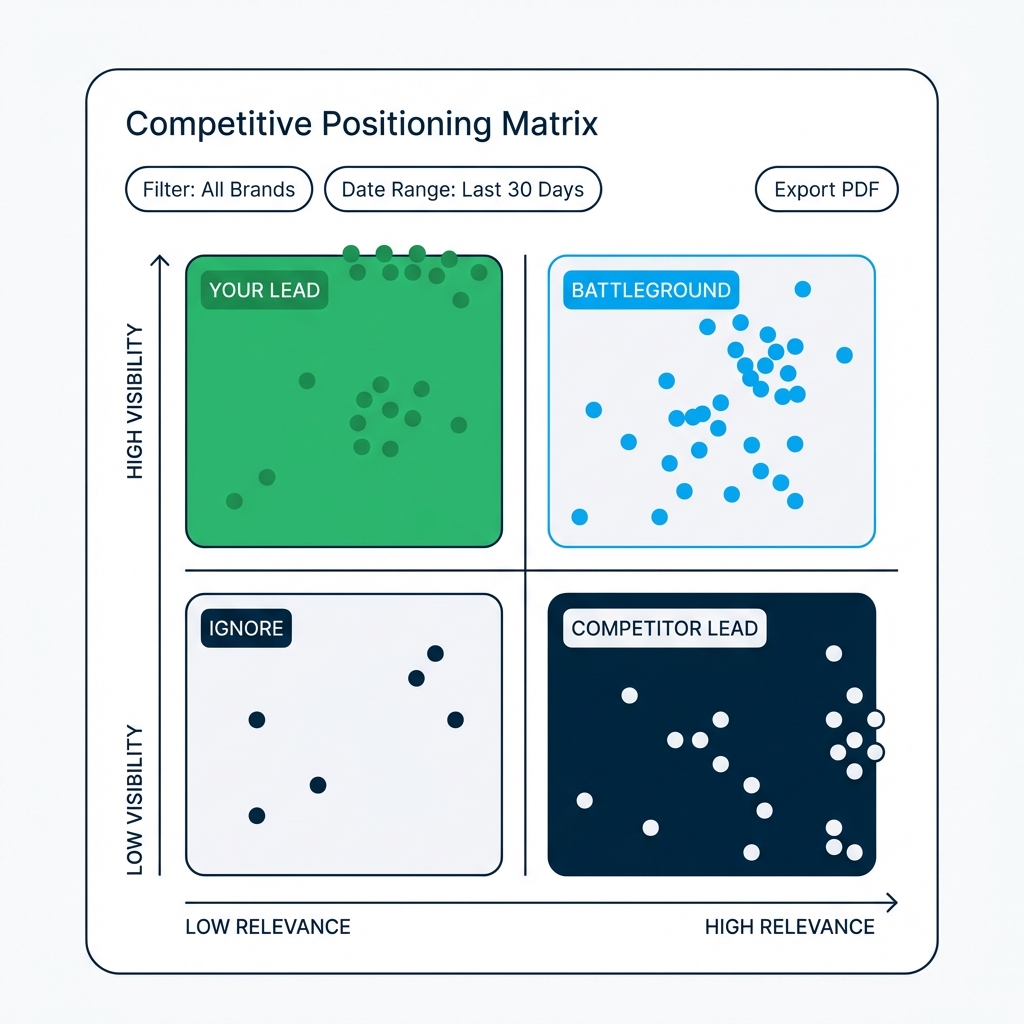
Your Lead: High relevance, you dominate → Defend Competitor Lead: High relevance, they dominate → Attack Battleground: High relevance, contested → Invest heavily Ignore: Low relevance → Deprioritize
Platforms like AICarma automate this visualization through a Visibility & Sentiment matrix, placing brands into quadrants from "Low Performance" to "Leaders" based on real-time prompt testing across 10+ AI models.
Reverse-Engineering Winning Strategies
When a competitor consistently outperforms you, reverse-engineer why:
The Technical Audit
| Factor | How to Check | What to Look For |
|---|---|---|
| robots.txt | Visit competitor.com/robots.txt | Are they allowing AI crawlers? |
| Schema | Rich Results Test | Depth and quality of structured data |
| Page Speed | PageSpeed Insights | Faster = easier to crawl |
| Content Structure | Manual review | Are they optimized for chunks? |
| llms.txt | Check competitor.com/llms.txt | Are they using this standard? |
The Entity Audit
| Source | How to Check | What to Look For |
|---|---|---|
| Crunchbase | Search their profile | Completeness of information |
| Wikipedia | Search Wikipedia | Do they have an article? |
| G2/Capterra | Search their profile | Reviews, ratings, completeness |
| Search subreddits | Are they discussed? Positively? | |
| News Coverage | Google News | Recent press coverage? |
The Content Audit
| Factor | What to Analyze | Advantage Indicator |
|---|---|---|
| FAQ Content | Do they have comprehensive FAQs? | AI often quotes FAQ directly |
| Comparison Pages | "X vs Y" content? | Controls competitor comparisons |
| Pricing Transparency | Is pricing public? | AI prefers quotable prices |
| Original Research | Proprietary data/studies? | Unique citing opportunities |
The Prompt Victory Analysis
When you and a competitor both appear in AI results, who "wins"? Analyze prompt victories:
Victory Types
| Victory Type | Definition | Value |
|---|---|---|
| Position Win | You're listed first | High |
| Recommendation Win | You're explicitly recommended | Very High |
| Detail Win | More accurate/detailed description | Medium |
| Sentiment Win | More positive framing | Medium |
| Exclusive Win | You appear, competitor doesn't | Very High |
Tracking Prompt Victories
For each key prompt, track over time:
| Prompt | Week 1 | Week 2 | Week 3 | Week 4 | Trend |
|---|---|---|---|---|---|
| "Best CRM" | A wins | A wins | Tie | You win | ↗️ |
| "CRM for startups" | A wins | A wins | A wins | A wins | → |
| "vs Competitor A" | Tie | You win | Tie | You win | ↗️ |
Patterns emerge. Maybe you're gaining on comparison prompts but losing on category prompts.
Adversarial Prompt Testing
Push harder to understand competitive dynamics:
| Adversarial Prompt | What It Reveals |
|---|---|
| "Why is [Competitor] better than [You]?" | How AI positions their advantages |
| "Problems with [Competitor]" | Weaknesses AI associates with them |
| "When should I NOT use [Competitor]?" | Contexts where you might win |
| "[Competitor] alternatives" | Whether you appear as substitute |
Identifying Strategic Vulnerabilities
Every competitor has vulnerabilities in AI visibility. Find them:
Common Visibility Vulnerabilities
| Vulnerability | How to Detect | Exploitation Strategy |
|---|---|---|
| robots.txt Block | Check their file | They can't update AI's knowledge |
| Weak Entity Presence | AI describes them vaguely | Build your entity strength |
| No FAQs | Check their site | Create comprehensive FAQ content |
| Outdated Information | AI cites old pricing/features | Ensure yours is current |
| Negative Reddit Sentiment | Search Reddit for their brand | Build positive community presence |
| No Wikipedia | Check for article | If you're notable, establish presence |
| Contact-Sales Pricing | Check their site | Make your pricing transparent |
The "Why Not Them?" Analysis
Ask AI directly: "What are the limitations of [Competitor]?" "When would you NOT recommend [Competitor]?" "What's [Competitor] missing that alternatives have?"
These responses reveal the attack angles AI considers valid.
Building Your Competitive Monitoring System
Weekly Monitoring
Run these checks weekly:
| Check | Method | Time Required |
|---|---|---|
| Category visibility | Run 5-10 category prompts × 3 platforms | 30 min |
| Position tracking | Note ranking order | Included above |
| New competitor detection | Look for new brands appearing | 10 min |
Monthly Analysis
| Analysis | Method | Time Required |
|---|---|---|
| Competitor strategy changes | Audit top 3 competitor sites | 2 hours |
| Entity presence check | Review directories/Wikipedia | 1 hour |
| Content gap analysis | Compare content coverage | 2 hours |
| Victory trend analysis | Compile weekly data | 30 min |
Quarterly Strategic Review
| Review | Method | Time Required |
|---|---|---|
| Full competitive landscape | Comprehensive prompt testing | 4 hours |
| Strategy adjustment | Based on findings | 2 hours |
| Investment prioritization | Allocate resources | 2 hours |
Automated Competitive Intelligence
For continuous monitoring, AICarma can automate competitive intelligence:
- Continuous visibility tracking across 10+ LLM models simultaneously
- Competitor benchmarking with Visibility, Sentiment, and Ranking metrics
- Source usage analysis showing which domains (Reddit, Wikipedia, TechCrunch) influence AI recommendations about each competitor
- Automated alerts when competitors gain or lose significant share
- Historical trend analysis for strategic planning
Offensive and Defensive Strategies
Offensive Strategies: Capturing Share
| Strategy | Tactic | Timeline |
|---|---|---|
| Prompt Domination | Create content targeting winning competitor's prompt categories | 2-3 months |
| Entity Strengthening | Build presence in sources competitor is absent from | 3-6 months |
| Comparison Content | Create "X vs Us" pages that you control | 1 month |
| Community Presence | Establish authentic Reddit presence | Ongoing |
| Original Research | Publish data competitor can't replicate | Variable |
Defensive Strategies: Protecting Position
| Strategy | Tactic | Frequency |
|---|---|---|
| Monitoring Alerts | Track competitor visibility changes | Continuous |
| Entity Maintenance | Keep all profiles updated | Monthly |
| Content Freshness | Update key pages regularly | Quarterly |
| Negative Monitoring | Watch for competitor comparison content | Weekly |
| Technical Audit | Ensure no degradation in crawlability | Monthly |
Case Study: Capturing Share of Model from a Competitor
Scenario: Analytics SaaS company trailing category leader by 25 visibility points
Starting Position:
- Our visibility: 22%
- Competitor visibility: 47%
- Gap: 25 points
Competitive Analysis Findings:
- Competitor had strong Wikipedia presence (we had none)
- Competitor's robots.txt allowed AI; ours was blocking GPTBot
- Competitor had 15+ comparison articles; we had 2
- Competitor had active Reddit presence; we had minimal
- Their Schema was twice as comprehensive as ours
90-Day Attack Plan:
| Month 1 | Month 2 | Month 3 |
|---|---|---|
| Fix robots.txt | Launched 8 comparison articles | Published original research |
| Audit Schema gaps | Started Reddit engagement | Maintained momentum |
| Attempted Wikipedia | Submitted to industry directories | Updated all profiles |
| Created FAQ sections | Enhanced entity presence | Monitored and adjusted |
Results:
| Metric | Before | After | Change |
|---|---|---|---|
| Our visibility | 22% | 39% | +17 pts |
| Competitor visibility | 47% | 44% | -3 pts |
| Gap | 25 pts | 5 pts | -20 pts |
| Category prompt wins | 12% | 38% | +26 pts |
Key insight: We didn't need to beat them everywhere. Closing the gap by exploiting their specific vulnerabilities (stale comparison content, minimal FAQ) gave us meaningful share even without matching their entity strength.
FAQ
Can competitors see my AI visibility score?
If they're systematically testing, yes. Just as you can monitor their visibility, they can monitor yours. Assume sophisticated competitors are tracking. This makes both offense and defense important.
Should I create "Why We're Better Than [Competitor]" content?
Yes, but carefully. Comparison content should be factual and fair—AI systems can detect and penalize overtly biased comparisons. Focus on genuine differentiators rather than attacks.
What if my competitor has insurmountable advantages (Wikipedia, major brand)?
Focus on niches. Even if a competitor dominates "best CRM," you might win "best CRM for solo consultants" or "best CRM with Notion integration." Find the long-tail prompts where you have authentic advantages.
How often do competitive positions shift?
More often than traditional SEO. AI visibility is volatile—positions can shift weekly with model updates or new training data. Continuous monitoring is essential.
Is competitive intelligence for AI legal?
Yes. Querying public AI systems with prompts is no different from searching Google. You're using publicly available services to understand the competitive landscape—standard competitive intelligence practices.