
Training Data SEO: How to Get Your Brand Into AI Model Weights
Last Updated: June 28, 2025
Here's a question that will reframe how you think about AI visibility: Where does ChatGPT's knowledge about your brand actually come from?
The answer isn't "your website" (at least not directly). ChatGPT's base knowledge comes from its training data—massive datasets like Common Crawl, Wikipedia, books, and curated web text. When an LLM "knows" that Salesforce is a CRM company, that knowledge was baked into the model during training, not learned by crawling Salesforce.com.
This is fundamentally different from how Google works. Google indexes the live web continually. But LLMs learn once (during training), then freeze that knowledge until the next training cycle.
The implication: If you weren't in the training data—or were represented poorly—you're fighting an uphill battle. Your brand may be fundamentally invisible or misrepresented at the model level, regardless of what's on your website today.
Training Data SEO is the practice of ensuring your brand is accurately and prominently represented in the datasets used to train future AI models. It's a long game, but it might be the most important visibility investment you make. For enterprises weighing this investment, understanding the economics of AI monitoring platforms provides essential context.
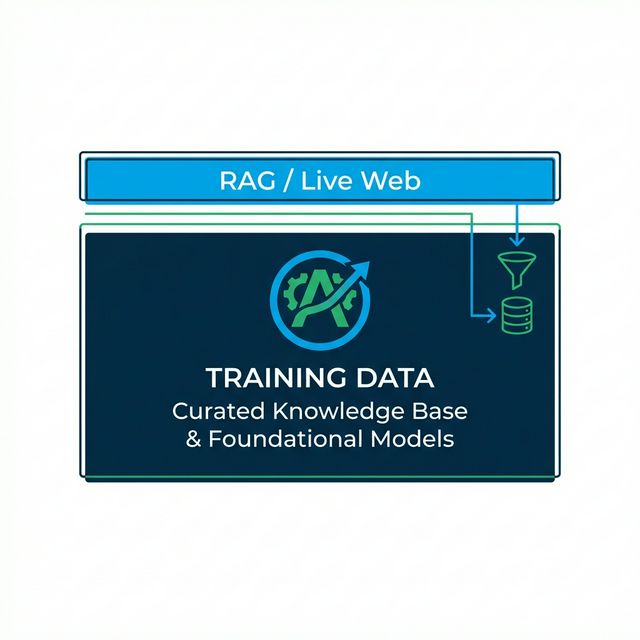
Table of Contents
- How AI Training Data Works
- The Major Training Data Sources
- Why Training Data Matters for Visibility
- Assessing Your Training Data Presence
- Infiltrating Common Crawl
- Wikipedia and Wikidata Strategy
- Reddit: The Unofficial Training Ground
- Press and Publication Strategy
- Timeline and Expectations
- FAQ
How AI Training Data Works
The Training Process (Simplified)
1. Collect massive text datasets (trillions of tokens)
2. Clean and filter for quality
3. Train neural network on next-word prediction
4. Model learns patterns, facts, associations
5. Fine-tune for specific behaviors
6. Deploy model (knowledge is now frozen)
Key insight: Steps 1-4 determine what the model "knows." After deployment, the model's core knowledge is static until retrained.
The Knowledge Freezing Problem
| Training Cutoff | Model Knowledge |
|---|---|
| April 2023 | Knows nothing after this date |
| December 2023 | Includes late 2023 events |
| April 2024 | Current information up to cutoff |
If your product launched after the training cutoff, the base model literally doesn't know it exists. RAG and browsing can help, but base knowledge is foundational.
Why Base Knowledge Matters
Even with RAG (Retrieval-Augmented Generation), base knowledge provides:
- Entity recognition: Model knows what "Salesforce" means
- Association patterns: Model connects "CRM" with "Salesforce"
- Confidence calibration: Strong training presence = more confident citations
- Default recommendations: For vague queries, training influences defaults
If the model's base knowledge says "HubSpot is a leading marketing platform" but has no training data about your company, guess who gets recommended when context is ambiguous?
The Major Training Data Sources
Understanding what's in training data helps you target presence there:
Tier 1: Most Heavily Weighted
| Source | Content Type | Training Weight |
|---|---|---|
| Wikipedia | Encyclopedic knowledge | Very High |
| Common Crawl | Web at large | High (filtered) |
| Books | Long-form text | High |
| Academic papers | Scientific/technical | High |
Tier 2: Significant Influence
| Source | Content Type | Training Weight |
|---|---|---|
| Discussion forums | Moderate-High | |
| StackOverflow | Technical Q&A | Moderate-High |
| News articles | Current events | Moderate |
| GitHub | Code and tech docs | Moderate |
Tier 3: Present but Filtered
| Source | Content Type | Notes |
|---|---|---|
| General web pages | Mixed quality | Heavy filtering applied |
| Social media | Short-form | Often excluded |
| Forums | Discussion | Quality-dependent |
Filtering Reality
AI companies don't use the raw web. They filter for:
- Quality (not spam, not low-effort)
- Authority (established sources preferred)
- Diversity (not too much from one domain)
- Safety (excluding harmful content)
Your homepage might be in Common Crawl, but that doesn't mean it made the training cut.
Why Training Data Matters for Visibility
The Entity Confidence Effect
When a brand has strong training presence:
- AI "knows" the brand fundamentally
- Responses are confident, not hedged
- Recommendations are specific, not vague
When a brand has weak training presence:
- AI treats the brand as uncertain
- Responses include hedges ("apparently," "reportedly")
- Brand may be omitted in favor of known alternatives
Example Difference
Strong training presence:
"For CRM software, Salesforce is the market leader, offering Sales Cloud, Service Cloud, and Marketing Cloud. It's best suited for enterprise organizations."
Weak training presence:
"There are various CRM options available. Based on recent information, [YourBrand] appears to be a CRM solution, though I don't have detailed information about its features."
Which one would you rather have representing your brand?
The Compounding Effect
Training data presence compounds:
- AI mentions you → Users discuss you
- User discussions get indexed → More training data
- Next training cycle → Stronger presence
- Stronger presence → More confident recommendations
- More recommendations → More discussion → Repeat
The rich get richer. Establishing early presence builds a moat.
Assessing Your Training Data Presence
The Knowledge Test
Ask AI about your brand without browsing/RAG:
- "What is [Your Brand]?" (Does it know?)
- "What does [Your Brand] do?" (Accurate?)
- "Who founded [Your Brand]?" (Details?)
- "How does [Your Brand] compare to [Competitor]?" (Position?)
If AI gives accurate, confident answers, you have training presence. If it hedges or hallucinates, you don't.
Signals of Strong Presence
| Signal | Meaning |
|---|---|
| Accurate unprompted description | Entity is well-established |
| Confident tone | High training weight |
| Specific details | Multiple training sources |
| Context-appropriate mentions | Strong associations |
Signals of Weak Presence
| Signal | Meaning |
|---|---|
| "I don't have information about..." | Not in training data |
| Hallucinated details | Weak or conflicting data |
| Hedged language | Low confidence |
| Confusion with other entities | Weak entity signal |
Infiltrating Common Crawl
Common Crawl is the largest open web archive, used by many AI training pipelines.
How Common Crawl Works
Common Crawl regularly crawls the web and provides free access to the data. AI companies filter this data for quality, then include selected content in training.
Getting into Common Crawl
-
Your site must be crawlable
- Allow bots in robots.txt
- Ensure pages load without JavaScript (or SSR)
- Have reasonable site architecture
-
Your content must be quality
- Original, substantive content
- Minimal ads and navigation clutter
- Text-heavy (not just images)
-
Your site must have authority signals
- Backlinks from authoritative sites
- Domain age and history
- HTTPS, fast loading
Beyond Your Own Site
Your brand's training representation includes:
- Mentions of you on other sites
- Reviews and discussions about you
- News coverage mentioning you
- Wikipedia/reference content about you
These may be more impactful than your own site content.
Wikipedia and Wikidata Strategy
Wikipedia is disproportionately important for training data—it's high-quality, factual, and heavily weighted.
Wikipedia Requirements
Wikipedia has strict notability requirements. You need:
- Significant coverage in reliable, independent sources
- Multiple sources (not just press releases)
- Evidence of enduring significance
You cannot create a Wikipedia page about yourself. Others must write it, citing independent sources.
Building Notability
| Action | Purpose |
|---|---|
| Get press coverage | Creates citable sources |
| Academic/research mentions | High-quality citations |
| Industry awards | Demonstrates significance |
| Regulatory filings (if applicable) | Verifiable sources |
Wikidata: The Easier Path
Wikidata is the structured knowledge base behind Wikipedia. It has lower notability requirements and provides:
- Entity definitions
- Relationship mappings
- Knowledge Graph data
You can create a Wikidata entry for your company even without a Wikipedia article.
Wikidata Implementation
Create an entry with:
- Instance of: Company/Organization
- Industry
- Headquarters location
- Founding date
- Founders (link to Person entities)
- Official website
- Social media links
This establishes your entity in structured knowledge bases.
Reddit: The Unofficial Training Ground
Reddit has become surprisingly influential for AI training—companies including OpenAI have data licensing deals with Reddit.
Why Reddit Matters
- Authentic user discussions (not marketing fluff)
- Question-answer format (great for training)
- Diverse topics and perspectives
- High engagement signals quality discussions
Reddit Strategy for Training Data
Don't spam. AI companies (and Reddit) are sophisticated. They can detect promotional spam.
Instead:
- Participate authentically in relevant subreddits
- Provide genuine value in discussions
- Build personal authority before mentioning brand
- Respond to questions where your product is genuinely helpful
- Let users mention your brand organically
Long-Term Reddit Presence
| Phase | Focus | Timeline |
|---|---|---|
| Observe | Learn subreddit culture | 1 month |
| Participate | Add value without promotion | 3 months |
| Establish | Build credible username | 6 months |
| Integrate | Occasional relevant brand mentions | Ongoing |
Learn more: Reddit GEO Strategy
Press and Publication Strategy
News and publication mentions influence training data:
Target Publications
| Type | Examples | Training Value |
|---|---|---|
| Major news | NYT, WSJ, BBC | Very High |
| Tech publications | TechCrunch, Wired | High |
| Industry publications | Trade journals | Medium-High |
| Press releases alone | Your own releases | Low |
What Creates Coverage
| Coverage Driver | Newsworthiness |
|---|---|
| Product launches | Medium (if differentiated) |
| Funding announcements | High for startups |
| Original research/data | Very High |
| Founder opinions/predictions | Medium-High |
| Industry trend analysis | High |
| Acquisitions/partnerships | High |
The Publication Strategy
Don't just issue press releases—create genuine news:
- Conduct original research in your industry
- Publish data others can cite
- Develop contrarian takes on trends
- Partner with researchers for studies
- Speak at conferences (transcripts become content)
Timeline and Expectations
The Long Game Reality
| Action | Visibility Impact Timeline |
|---|---|
| Publish on your site | Days to weeks (for RAG) |
| Optimize Schema | Days to weeks (for RAG) |
| Build Reddit presence | 3-6 months |
| Get press coverage | 6-12 months (for next training cycle) |
| Establish Wikipedia | 6-18 months |
| See training data effects | Next model release (6-12+ months) |
Training data SEO is not quick wins—it's foundational investment.
Phased Approach
Phase 1 (Months 1-3): Quick wins
- robots.txt optimization
- Schema markup
- Review platform profiles
- Wikidata entry
Phase 2 (Months 3-6): Authority building
- Content marketing for press
- Reddit participation
- Original research publication
- Directory completeness
Phase 3 (Months 6-12): Training data targeting
- Press/publication strategy
- Wikipedia notability building
- Sustained Reddit presence
- Partnership for research
Phase 4 (Months 12+): Maintenance
- Monitor AI responses for accuracy using AICarma or similar multi-model tracking
- Update information sources
- Maintain activity across channels
- Repeat research and press
FAQ
Does my website content directly become training data?
Possibly, but not directly. Your site may be in Common Crawl, but AI companies heavily filter. Direct impact is uncertain. What's more predictable: mentions of you on authoritative third-party sources (Wikipedia, news, Reddit) are more reliably included in training.
If I can't make a Wikipedia page about myself, how do I get one?
Build notability, then let others create it. Get covered by major publications. Be cited in academic papers. Win industry awards. Once sufficient independent sources exist, a Wikipedia editor may create your page—or you can request it through official channels (with disclosure).
How do I know if my content made it into AI training data?
You can't know definitively. AI companies don't publish exact training datasets. The best proxy: test whether AI "knows" about you without browsing. If it has accurate, confident information, you likely have training presence.
Is this ethical? Am I manipulating AI?
You're not manipulating—you're ensuring accurate representation. AI systems will form opinions about your category whether you're present or not. Ensuring you're represented accurately and prominently is no different than PR, just for a different audience.
What about AI companies that block training on my content?
Some companies let you opt-out of training via robots.txt or specific signals. But opting out means opting out of visibility. For most commercial entities, being in training data is beneficial—you want AI to know about you.