
Schema Markup Strategy for AI: Speaking the Language of Large Language Models
Last Updated: November 12, 2025
Let me share a secret that most marketers don't understand yet: while everyone obsesses over keywords and backlinks, the real battle for AI visibility is being won in JSON-LD.
Schema markup—that cryptic code your developer reluctantly adds to your pages—has evolved from a "nice-to-have" SEO tactic (get some stars in search results!) into a critical survival mechanism for the AI era. It's no longer about impressing Google's algorithm. It's about instructing Large Language Models exactly who you are, what you sell, and why you matter.
Here's the fundamental truth: humans read text; machines read Schema. When ChatGPT crawls your page, it encounters a messy soup of HTML, CSS, and marketing copy. But when it finds your Schema markup, it receives clean, deterministic facts that it can trust and cite.
If text is your brand speaking to humans, Schema is your brand speaking to machines. And in the Three Internets framework, the machines are increasingly the gatekeepers to the humans.
Let's master this language.
Table of Contents
- Why Schema Matters More in the AI Era
- The Core Schemas Every Business Needs
- Advanced Strategy: Entity Nesting and Relationships
- Schema for Different Business Types
- Implementation Guide: Step-by-Step
- The FAQ Schema Advantage
- Validation and Testing
- Common Mistakes and How to Avoid Them
- The Schema Implementation Checklist
- FAQ
Why Schema Matters More in the AI Era
The Old World: Schema for Rich Snippets
In traditional SEO, Schema markup served primarily one purpose: triggering rich results in Google. Add Recipe schema, get a recipe card. Add Review schema, get stars. Nice to have, but not essential.
The New World: Schema for LLM Comprehension
Large Language Models consume billions of web pages. They need to understand:
- What type of content is this?
- Who created it?
- What facts can I trust?
- How do entities relate to each other?
When an LLM encounters your page, it has two options:
- Probabilistic inference: Parse your text and guess what things mean
- Deterministic reading: Read your Schema and know what things mean
Option 1 leads to hallucinations, misattributions, and confusion. Option 2 leads to accurate citations and correct recommendations.
| Aspect | Without Schema | With Schema |
|---|---|---|
| Entity Recognition | AI guesses your company type | AI knows you're a "SoftwareApplication" |
| Relationship Mapping | AI might confuse your product reviews with competitor | AI knows this Review belongs to THIS Product |
| Fact Confidence | Low—AI might not cite "uncertain" info | High—AI treats structured data as reliable |
| Citation Accuracy | May misquote or misattribute | Precise attribution |
| Recommendation Inclusion | Hit or miss | Significantly improved |
The Compounding Effect
Here's what makes Schema so powerful: it works both for traditional SEO AND Generative Engine Optimization. You're not choosing between channels—you're optimizing for both simultaneously.
The Core Schemas Every Business Needs
Regardless of your industry, certain schemas form the foundational layer of your entity presence:
1. Organization Schema: Your Digital Identity Card
This is non-negotiable. Every business website needs Organization schema on the homepage.
{
  "@context": "https://schema.org",
  "@type": "Organization",
  "name": "AICarma",
  "url": "https://aicarma.io",
  "logo": "https://aicarma.io/logo.png",
  "description": "AI Visibility monitoring and Generative Engine Optimization platform",
  "foundingDate": "2023",
  "founders": [
    {
      "@type": "Person",
      "name": "Founder Name"
    }
  ],
  "sameAs": [
    "https://www.linkedin.com/company/aicarma",
    "https://twitter.com/aicarma",
    "https://www.crunchbase.com/organization/aicarma"
  ],
  "contactPoint": {
    "@type": "ContactPoint",
    "contactType": "customer service",
    "email": "support@aicarma.io"
  }
}
Critical Fields for AI:
- sameAs: These links verify your identity across platforms. AI uses them to build confidence that all mentions of "AICarma" refer to the same entity.
- description: Make it factual and quotable, not marketing fluff.
- foundingDate: Establishes legitimacy and longevity.
2. Product/Service Schema: What You Actually Sell
For every product or service page, add detailed Product or Service schema.
{
  "@context": "https://schema.org",
  "@type": "SoftwareApplication",
  "name": "AICarma Pro",
  "applicationCategory": "BusinessApplication",
  "operatingSystem": "Web browser",
  "offers": {
    "@type": "Offer",
    "price": "299",
    "priceCurrency": "USD",
    "priceValidUntil": "2026-12-31",
    "availability": "https://schema.org/InStock"
  },
  "aggregateRating": {
    "@type": "AggregateRating",
    "ratingValue": "4.8",
    "reviewCount": "127"
  },
  "featureList": [
    "Real-time AI visibility monitoring",
    "Multi-model tracking (ChatGPT, Claude, Gemini)",
    "Competitor analysis",
    "Automated alerts"
  ]
}
Why This Matters for AI Agents:
- AI agents making purchase decisions need structured data to compare options
- The
offersblock provides machine-readable pricing—critical for inclusion in comparison tables featureListgives the AI specific capabilities to cite
3. FAQPage Schema: Direct Injection of Q&A
FAQPage schema is perhaps the most powerful tool for Answer Engine Optimization. You're literally feeding question-answer pairs directly to the AI.
{
  "@context": "https://schema.org",
  "@type": "FAQPage",
  "mainEntity": [
    {
      "@type": "Question",
      "name": "What is AI Visibility Score?",
      "acceptedAnswer": {
        "@type": "Answer",
        "text": "AI Visibility Score measures how often your brand appears in AI-generated responses across ChatGPT, Claude, and Gemini. It's the AI-age equivalent of Share of Voice."
      }
    },
    {
      "@type": "Question",
      "name": "How does AICarma track AI mentions?",
      "acceptedAnswer": {
        "@type": "Answer",
        "text": "AICarma runs thousands of prompts daily across multiple AI models, tracking when your brand is mentioned, the sentiment of mentions, and your ranking relative to competitors."
      }
    }
  ]
}
Pro Tip: FAQ schema often gets quoted verbatim by AI. Craft your answers to be quotable—specific, factual, and self-contained.
4. Article/BlogPosting Schema: Authorship and Expertise
For content marketing, Article schema establishes E-E-A-T signals:
{
  "@context": "https://schema.org",
  "@type": "Article",
  "headline": "The Complete Guide to Schema Markup for AI",
  "author": {
    "@type": "Person",
    "name": "Author Name",
    "url": "https://aicarma.io/team/author-name"
  },
  "datePublished": "2025-11-12",
  "dateModified": "2025-11-12",
  "publisher": {
    "@type": "Organization",
    "name": "AICarma",
    "logo": {
      "@type": "ImageObject",
      "url": "https://aicarma.io/logo.png"
    }
  },
  "mainEntityOfPage": {
    "@type": "WebPage",
    "@id": "https://aicarma.io/blog/schema-markup-strategy/"
  }
}
Advanced Strategy: Entity Nesting and Relationships
Here's where most Schema implementations fail: they treat entities as isolated objects. But real-world entities exist in relationships, and AI needs to understand these relationships to form accurate mental models.
The Problem with Flat Schema
Bad (Isolated entities):
{"@type": "Organization", "name": "Acme Corp"}
{"@type": "Product", "name": "Acme Widget"}
{"@type": "Review", "reviewBody": "Great product!"}
The AI sees three separate things. Does this review relate to the product? Does the product belong to the organization? Unknown.
The Solution: Nested Schema
Good (Nested relationships):
{
  "@type": "Organization",
  "name": "Acme Corp",
  "makesOffer": {
    "@type": "Offer",
    "itemOffered": {
      "@type": "Product",
      "name": "Acme Widget",
      "review": {
        "@type": "Review",
        "reviewBody": "Great product!",
        "author": {
          "@type": "Person",
          "name": "Happy Customer"
        },
        "reviewRating": {
          "@type": "Rating",
          "ratingValue": 5
        }
      }
    }
  }
}
Now the AI understands: Acme Corp makes an offer for a product called Acme Widget, which has a review from a person. The relationship is unambiguous.
Entity Relationship Graph
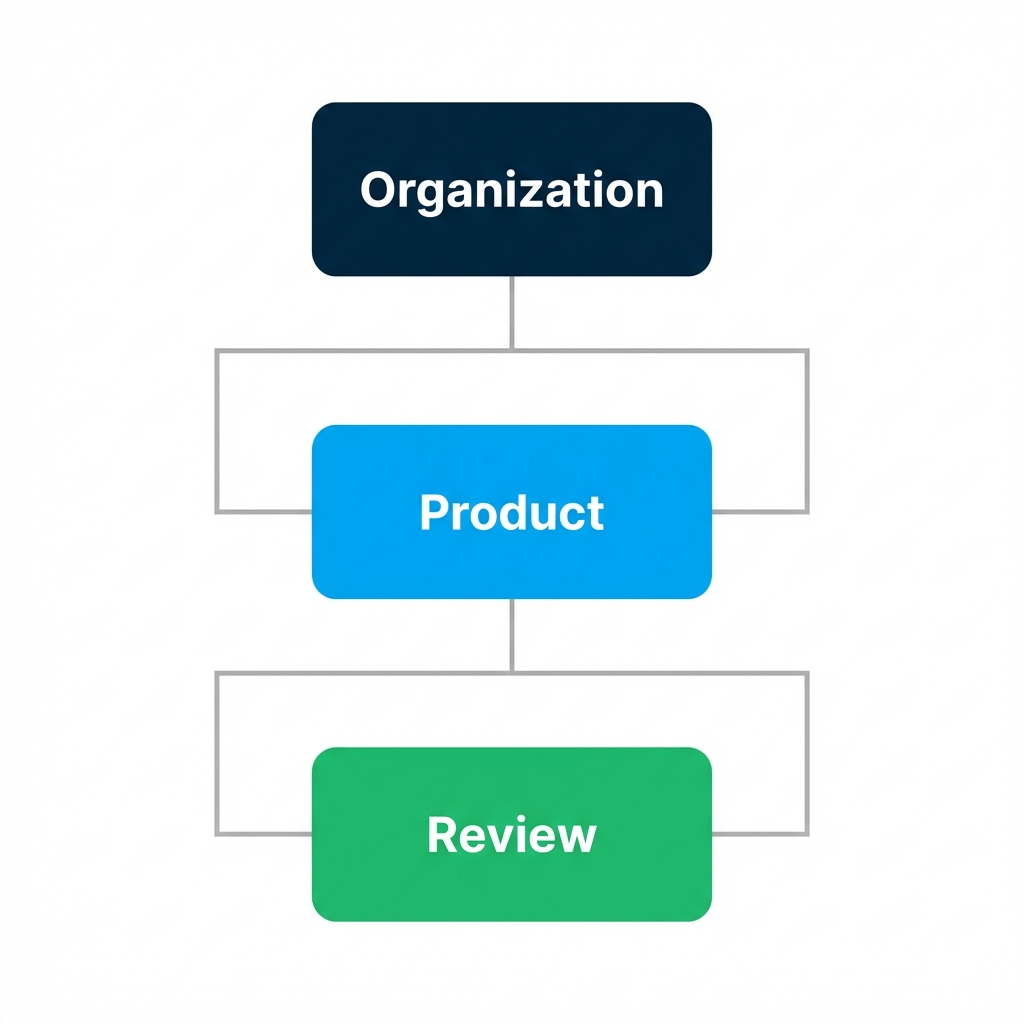
Key Nesting Relationships
| Parent Entity | Relationship | Child Entity |
|---|---|---|
| Organization | makesOffer / offers | Offer / Product |
| Product | review | Review |
| Product | manufacturer | Organization |
| Article | author | Person |
| Person | worksFor | Organization |
| LocalBusiness | containsPlace | Place |
Schema for Different Business Types
B2B SaaS Companies
Priority schemas:
- SoftwareApplication: Product definition
- Organization: Company identity
- FAQPage: Feature questions, pricing questions
- Article: Thought leadership content
Special considerations:
- Include
offerswith clear pricing (avoid "Contact Sales") - Use
featureListfor comparison data - Connect to review platforms via
sameAs - Read more: SaaS GEO Playbook
E-Commerce / Retail
Priority schemas:
- Product: Every product page
- Offer: Pricing and availability
- AggregateRating: Review summaries
- BreadcrumbList: Navigation context
Special considerations:
- Include GTIN/SKU identifiers
- Use
availabilitystatus - Add
shippingDetailsandreturnPolicy - Read more: AI Commerce Optimization
Local Businesses
Priority schemas:
- LocalBusiness (or specific subtype like Restaurant, Dentist)
- OpeningHoursSpecification: Operating hours
- GeoCoordinates: Location data
- FAQPage: Common local queries
Special considerations:
- Ensure NAP consistency with all directories
- Include
areaServedfor service areas - Add
priceRangeindicator - Read more: Local AI SEO
Content Publishers / Media
Priority schemas:
- Article / NewsArticle: Every article
- Person: Author pages
- FAQPage: Topic questions
- HowTo: Tutorial content
Special considerations:
- Emphasize author credentials for E-E-A-T
- Use
dateModifiedfor freshness signals - Consider
ClaimReviewfor fact-checking content
Implementation Guide: Step-by-Step
Step 1: Audit Your Current Schema
Visit Google's Rich Results Test and test your key pages. Note what Schema types are present and what's missing.
Step 2: Prioritize by Page Value
| Page Type | Priority | Required Schema |
|---|---|---|
| Homepage | Critical | Organization |
| Product/Service Pages | Critical | Product/Service + Offer |
| Pricing Page | Critical | Offer + FAQPage |
| Blog Posts | High | Article + FAQPage |
| About Page | High | Organization + Person (founders) |
| FAQ Page | High | FAQPage |
| Contact Page | Medium | ContactPoint |
| Team Pages | Medium | Person + worksFor |
Step 3: Implement JSON-LD
JSON-LD is the recommended format. Add it to your page's <head> or before the closing </body>:
<script type="application/ld+json">
{
  "@context": "https://schema.org",
  "@type": "Organization",
  ...
}
</script>
Step 4: Connect Entities
Use @id references to link entities across pages:
Homepage:
{
  "@type": "Organization",
  "@id": "https://yourdomain.com/#organization",
  "name": "Your Company"
}
Product Page:
{
  "@type": "Product",
  "manufacturer": {
    "@id": "https://yourdomain.com/#organization"
  }
}
Step 5: Validate and Monitor
After implementation:
- Re-test with Rich Results Test
- Check Google Search Console for structured data errors
- Monitor for changes in rich result appearances
- Track AI visibility changes with tools like AICarma
The FAQ Schema Advantage
FAQ schema deserves special attention because of its outsized impact on AI responses.
Why FAQ Schema Works So Well
- Direct Q&A format: Matches how users query AI
- Self-contained answers: Each Q&A is a complete thought
- Trust signal: Structured data implies editorial intent
- Quotable format: AI can cite verbatim
FAQ Schema Best Practices
| Do | Don't |
|---|---|
| Answer questions concisely (40-150 words) | Write essays in answers |
| Include specific data and numbers | Use vague marketing language |
| Cover actual customer questions | Make up questions for SEO |
| Update answers when products change | Let FAQ become stale |
| Make answers standalone (no "as mentioned above") | Reference other questions in answers |
Strategic FAQ Questions to Include
For every business:
- "What is [Your Product/Company]?"
- "How much does [Product] cost?"
- "What makes [Product] different from [Competitor Category]?"
- "Who should use [Product]?"
- "How to get started with [Product]?"
Validation and Testing
Automated Validation Tools
| Tool | Purpose | Link |
|---|---|---|
| Google Rich Results Test | Validate syntax, preview rich results | Link |
| Schema.org Validator | Check against Schema.org spec | Link |
| Google Search Console | Monitor structured data errors over time | GSC Dashboard |
Manual LLM Testing
This is the most important validation and it's rarely done:
- Copy your page's full HTML source
- Paste into ChatGPT or Claude
- Ask: "Based ONLY on the structured data in this source code, describe this company/product"
- Compare the AI's description to what you intended
If the AI can't accurately describe your entity from your Schema alone, your Schema isn't doing its job.
Testing Prompts
Try these with your Schema-enriched pages:
- "From the structured data, what is [Company Name]'s pricing?"
- "What features does [Product] have according to this page's schema?"
- "Who founded [Company] based on this markup?"
Common Mistakes and How to Avoid Them
Mistake 1: Schema That Doesn't Match Visible Content
Google explicitly warns against this, and it confuses AI too. If your Schema says price is $99 but your page shows $199, trust is destroyed.
Fix: Automate Schema generation from your product database to ensure sync.
Mistake 2: Missing Critical Properties
Having Organization schema without sameAs links is like having an identity card without a photo. Incomplete Schema is partially wasted Schema.
Fix: Use Schema.org documentation to identify required and recommended properties. Include all recommended properties at minimum.
Mistake 3: Orphaned Entities
Schema entities that don't connect to anything are weak signals. A lone Product schema without connection to an Organization, without Reviews, without Offers—it's floating in space.
Fix: Use nesting and @id references to build a connected entity graph.
Mistake 4: Static Schema on Dynamic Content
Your Schema says product is "InStock" but it's been sold out for a month. Now AI is recommending a product customers can't buy.
Fix: Generate Schema dynamically from your inventory/availability systems.
Mistake 5: Duplicate or Conflicting Schema
Multiple conflicting Organization schemas on different pages confuse AI about which information is canonical.
Fix: Audit for conflicts. Use a single authoritative schema pattern linked via @id.
The Schema Implementation Checklist
Use this checklist for every Schema implementation:
Foundation (All Sites)
- [ ] Organization schema on homepage with full
sameAslinks - [ ] Organization logo properly referenced
- [ ] Contact information in ContactPoint
- [ ] Description is factual and quotable
Product/Service Sites
- [ ] Product/Service schema on every offering page
- [ ] Pricing in Offer schema (real prices, not ranges)
- [ ] Features listed in featureList
- [ ] Reviews connected with AggregateRating
- [ ] Availability status accurate
Content Sites
- [ ] Article schema on every blog post
- [ ] Authors properly identified and linked
- [ ] Publication and modification dates accurate
- [ ] Publisher organization connected
All Sites (Advanced)
- [ ] FAQ schema on key pages with common questions
- [ ] BreadcrumbList for navigation context
- [ ] Entity nesting properly implemented
- [ ]
@idreferences connecting entities - [ ] No conflicts or duplications across pages
FAQ
Do LLMs really read and understand JSON-LD Schema?
Yes. Modern LLM crawlers (GPTBot, Googlebot, ClaudeBot) parse JSON-LD as a priority signal when analyzing page content. Schema is computationally cheaper to process than unstructured text, so crawlers naturally prefer it. OpenAI has not published internal details, but testing consistently shows that pages with comprehensive Schema get more accurate representation in AI responses.
Can I use Schema markup for B2B services that don't have traditional "products"?
Absolutely. Use the Service schema type nested within your Organization. You can define serviceType, areaServed, provider, and even offers for pricing. For complex B2B services, consider breaking down into multiple Service entities for different offerings.
What if I don't have technical skills to implement Schema?
You don't need to write code by hand. Options include: CMS plugins (Yoast, RankMath have Schema builders), dedicated Schema tools (Schema Pro, WP Schema), or even asking AI to generate it: "Generate nested JSON-LD Schema for a SaaS company that offers a project management tool priced at $29/month."
How often should I update my Schema markup?
Update immediately when: pricing changes, products launch or retire, company information changes, key features are added/removed. Audit quarterly to catch drift between Schema and page content.
Does Schema work for RAG-based AI systems like Perplexity?
Yes, but with a nuance. RAG systems retrieve content chunks to answer queries. Schema helps with: (1) accurate entity identification in retrieved chunks, (2) fact verification for the LLM, (3) structured data that's easier to cite. For RAG optimization, combine Schema with well-structured, self-contained content paragraphs.