
Invisible Brand Syndrome: Why Your Company Is Missing from ChatGPT (And How to Fix It)
Last Updated: April 22, 2025
Picture this scenario: You're the VP of Marketing at a mid-sized software company. Your SEO is crushing it. You rank #1 for your main keywords. Your domain authority is 75. You've built hundreds of quality backlinks. Your CMO is thrilled.
Then one day, a board member casually mentions: "I asked ChatGPT for the best software in our category, and it didn't even mention us. It recommended three of our smaller competitors instead."
Your stomach drops. Welcome to Invisible Brand Syndrome.
This isn't a hypothetical nightmare. It's happening right now to thousands of successful companies who've invested millions in traditional SEO while completely ignoring the new rules of AI discovery. The brands crushing it on Google are often ghosts in ChatGPT, Gemini, and Perplexity.
Let's diagnose this syndrome, understand why it happens, and most importantly—cure it.
Table of Contents
- What Is Invisible Brand Syndrome?
- The Symptoms: Are You Invisible?
- Self-Diagnosis: The Invisibility Test
- Root Cause #1: Low Training Data Authority
- Root Cause #2: Technical Access Barriers
- Root Cause #3: Content That Machines Can't Quote
- Root Cause #4: Weak Entity Presence
- The Visibility Recovery Plan: A 4-Phase Approach
- Case Study: From 0% to 45% Visibility in 90 Days
- Measuring Your Progress
- FAQ
What Is Invisible Brand Syndrome?
Invisible Brand Syndrome occurs when a company has strong traditional digital presence (good SEO, social following, industry recognition) but is completely absent from AI-generated recommendations and answers.
Here's the cruel irony: you can be the market leader in your industry, have the best product, and the strongest customer reviews—yet when someone asks an AI assistant "What's the best [your category]?", your name never comes up.
This isn't a glitch. It's a fundamental mismatch between how traditional search engines work and how Large Language Models form opinions.
| Traditional SEO | AI Visibility |
|---|---|
| Based on backlinks and authority signals | Based on training data representation |
| Real-time crawl and index | Frozen knowledge from training cutoff |
| Algorithm matches keywords to pages | Model probabilistically synthesizes answers |
| You can rank without being "understood" | You must be accurately represented in training data |
| Measured by rankings | Measured by citation frequency |
The key insight: Google doesn't need to understand your brand—it just matches query keywords to your content. But LLMs form actual opinions based on how well your brand is represented in their training data. If you're not in that data, or you're represented poorly, no amount of keyword optimization will save you. For enterprise brands, this has profound implications for corporate reputation management in the AI age.
The Symptoms: Are You Invisible?
Before we diagnose root causes, let's check for symptoms. Invisible Brand Syndrome manifests in several distinct ways:
Symptom 1: Zero Brand Mentions (The Complete Ghost)
You ask ChatGPT: "What are the best [your category] companies?" Your competitors are listed. You are not.
This is total invisibility—the AI genuinely doesn't know you exist, or doesn't consider you notable enough to mention.
Symptom 2: Generic or Hallucinated Descriptions (The Misunderstood Brand)
You ask: "Tell me about [Your Company]." The AI responds with something vague like "They are a company in the technology sector" or worse—provides completely false information about your products or services.
This means you exist in the training data, but your entity representation is weak or contaminated with incorrect information.
Symptom 3: Competitor Bias (The Second-Place Curse)
The AI consistently recommends your competitors for prompts where you should be the obvious answer. Even when you explicitly ask "Is [Your Brand] better than [Competitor]?", the response favors the competition.
This indicates your competitors have stronger entity representation and more positive sentiment in the training corpus.
Symptom 4: Inconsistent Presence (The Flickering Brand)
Sometimes you appear in AI responses, sometimes you don't. When you do appear, you're often mentioned last, with less detail than competitors.
This suggests borderline visibility—you exist, but your signal isn't strong enough to reliably surface.
Self-Diagnosis: The Invisibility Test
Want to know your actual status? Run this systematic test:
Step 1: Run the Category Prompt Ask ChatGPT/Claude/Gemini: "What are the top 10 [your product category] companies/tools?"
| Result | Diagnosis |
|---|---|
| You're in top 3 | Healthy visibility |
| You're in positions 4-10 | Weak visibility |
| You're not mentioned at all | Complete invisibility |
Step 2: Run the Comparison Prompt Ask: "Compare [Your Brand] vs [Top Competitor]"
| Result | Diagnosis |
|---|---|
| Detailed, accurate comparison | Strong entity presence |
| Vague or one-sided comparison | Weak entity presence |
| "I don't have enough information about [Your Brand]" | Near-complete invisibility |
Step 3: Run the Recommendation Prompt Ask: "I need [describe your ideal customer's problem]. What should I use?"
| Result | Diagnosis |
|---|---|
| You're recommended | Strong intent-matching |
| Competitors recommended | Weak intent-matching |
| Generic/unhelpful response | Category confusion |
Run these tests across ChatGPT, Claude, and Gemini. Your visibility often varies significantly between models because they're trained on different data.
Root Cause #1: Low Training Data Authority
Large Language Models are trained on massive datasets—Common Crawl, Wikipedia, Reddit, news sites, academic papers, and curated data from various sources. Here's the catch: not all sources are weighted equally.
The training process filters and prioritizes high-authority sources. If your brand only appears in:
- Low-traffic industry blogs
- Press releases that never got picked up
- Your own website (which may be excluded or down-weighted)
- Niche directories nobody reads
...then you have insufficient representation in the sources that actually shape LLM "opinions."
The Authority Hierarchy
Think of training data sources like a pyramid:
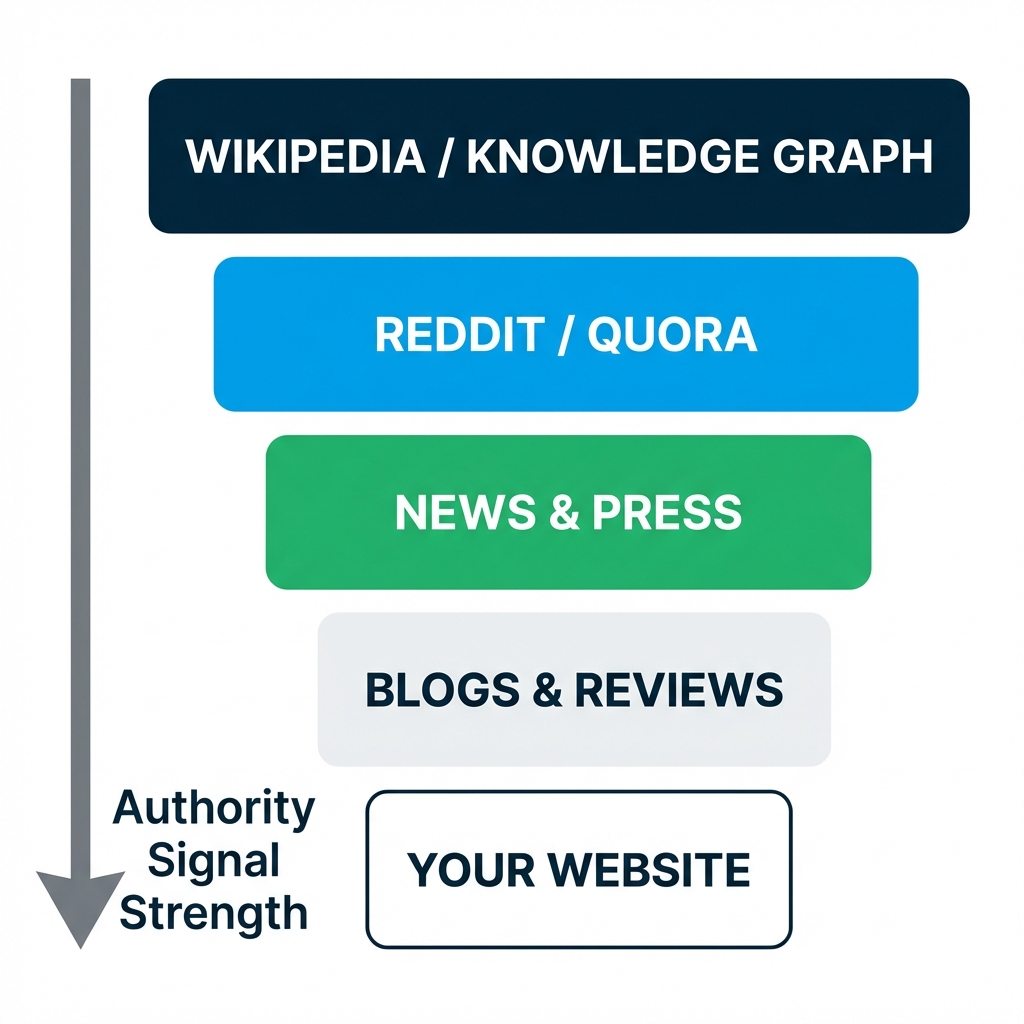
The Fix: You need representation in the upper layers of this pyramid. This means:
- Wikipedia entry (if you're notable enough to have one)
- Coverage in major publications (get actual press, not just press releases)
- Meaningful presence on Reddit
- Updated Crunchbase, LinkedIn, and G2 profiles
- Being discussed in Stack Overflow, Quora, or industry forums
Root Cause #2: Technical Access Barriers
Many companies unknowingly block AI crawlers from accessing their content. This is often an unintended consequence of "security" settings or outdated robots.txt configurations.
If GPTBot can't crawl your website, it can't learn about your products, pricing, or positioning. You've essentially locked yourself out of future training data.
Common Technical Barriers
| Barrier | Impact | Solution |
|---|---|---|
| robots.txt blocking GPTBot | Prevents OpenAI from crawling | Update your robots.txt |
| JavaScript-heavy site with no SSR | Content invisible to simple crawlers | Implement server-side rendering |
| Paywalled content | Premium content not included in training | Keep key pages public |
| Login-required sections | Profile, pricing, features not crawled | Make essential info public |
| Slow page load | Crawler timeouts | Optimize Core Web Vitals |
Quick Robots.txt Audit
Check your current robots.txt. If you see any of these, you might be blocking AI:
# DON'T DO THIS:
User-agent: GPTBot
Disallow: /

# OR THIS:
User-agent: *
Disallow: /
You want something more like:
# DO THIS:
User-agent: GPTBot
Allow: /
Disallow: /private/
Disallow: /admin/
Root Cause #3: Content That Machines Can't Quote
Here's a truth bomb: most marketing content is designed to persuade humans, not inform machines. The flowery language, the clever metaphors, the brand voice—LLMs often can't parse it into quotable facts.
AI models prefer citable content: specific claims, statistics, comparisons, and definitions that they can confidently include in an answer.
What AI Wants to Quote
| AI-Quotable Content | Non-Quotable Content |
|---|---|
| "[Product] offers 256-bit encryption at $29/month" | "Industry-leading security at competitive pricing" |
| "Founded in 2019, [Company] serves 10,000+ customers" | "We're a fast-growing startup with impressive traction" |
| "Features include: SSO, SAML, audit logs, custom roles" | "Enterprise-grade features your team will love" |
| "[Product] vs [Competitor]: 35% faster in benchmark tests" | "The fastest solution on the market" |
The Fix: Audit your content for "quotability." Every key page should contain:
- Specific numbers and percentages
- Clear feature lists (not marketing bullets)
- Explicit comparisons where defensible
- Definitions of what you do (not just why you're great)
This is where Schema Markup becomes crucial. Structured data gives machines the unambiguous facts they crave.
Root Cause #4: Weak Entity Presence
In the world of LLMs, you don't exist as a website—you exist as an entity. An entity is a concept that the model understands: Apple is a company that makes iPhones, Elon Musk is associated with Tesla and SpaceX, etc.
If your brand's entity is weak, the model might:
- Confuse you with similarly-named companies
- Have incomplete information about what you do
- Associate you with wrong products or industries
Building Entity Strength
Your entity is strengthened through:
- Consistent NAP: Name, Address, Phone identical across every directory
- Knowledge Graph Presence: Wikipedia, Wikidata, Google Knowledge Panel
- Schema Markup: Explicitly defining your entity properties on your own site
- Third-Party Validation: G2, Capterra, Crunchbase mentioning you consistently
- Media Coverage: Your name appearing in the context of your industry
Read our complete guide on Entity SEO and Knowledge Graph Optimization for the full playbook.
The Visibility Recovery Plan: A 4-Phase Approach
Now that we understand the root causes, here's a systematic plan to cure Invisible Brand Syndrome:
Phase 1: Foundation Fixes (Week 1-2)
Technical Access
- [ ] Audit and update robots.txt to allow AI crawlers
- [ ] Verify site is server-side rendered or has good static HTML fallbacks
- [ ] Ensure all public pages load under 3 seconds
- [ ] Check that pricing and feature pages are not behind login walls
Content Quotability
- [ ] Rewrite product pages with specific, factual claims
- [ ] Add comparison tables to feature pages
- [ ] Create a clear, fact-dense "About Us" page
- [ ] Implement Organization, Product, and FAQ schema
Phase 2: Entity Building (Week 3-4)
Knowledge Graph
- [ ] Claim and optimize your Crunchbase profile
- [ ] Claim and optimize your G2 / Capterra profiles
- [ ] Update LinkedIn company page with comprehensive info
- [ ] Check if you qualify for a Wikipedia page (don't create one if not notable)
- [ ] Create or update your Wikidata entry
Consistency Audit
- [ ] Verify NAP consistency across 20+ directories
- [ ] Ensure same company description appears everywhere
- [ ] Link all profiles back to your website with
sameAsschema
Phase 3: Training Data Penetration (Week 5-8)
Content Marketing for AI
- [ ] Publish original research that gets cited
- [ ] Create comprehensive comparison guides (fair, not promotional)
- [ ] Develop FAQ content targeting common purchase questions
- [ ] Write industry analyses that demonstrate expertise
Distribution Strategy
- [ ] Get coverage in major industry publications
- [ ] Participate actively in Reddit communities (authentically!)
- [ ] Create content that gets linked by authoritative sites
- [ ] Pursue podcast appearances that get transcribed
Phase 4: Monitoring & Maintenance (Ongoing)
- [ ] Set up AI visibility tracking with AICarma or similar tool
- [ ] Run monthly "invisibility tests" across ChatGPT, Claude, Gemini
- [ ] Monitor for hallucinated information and correct via Schema updates
- [ ] Track competitor visibility and identify gaps
Case Study: From 0% to 45% Visibility in 90 Days
Here's a real example (company name anonymized) of Invisible Brand Syndrome recovery:
The Company: A project management SaaS with 5,000 customers The Problem: Ranked #1 on Google for "best project management software" but 0% visibility in ChatGPT
Discovery Audit Findings:
- robots.txt was blocking all AI crawlers (accidentally, from a 2019 "security" update)
- Zero presence on Reddit despite active competitor discussions
- G2 profile was outdated with 2021 screenshots and old pricing
- Wikipedia page was blank stub (should have been deleted)
- Pricing was "Contact Sales" only—no public information for AI to cite
90-Day Intervention:
| Month 1 | Month 2 | Month 3 |
|---|---|---|
| Fixed robots.txt | Launched Reddit presence | Published 3 comparison guides |
| Updated all directory profiles | Got coverage in 2 industry blogs | Added FAQ schema to all pages |
| Created public pricing page | Published original survey data | Optimized for 10 high-intent prompts |
| Added comprehensive Schema | Collected 50+ new G2 reviews | Established monitoring |
Results:
- ChatGPT visibility: 0% → 45%
- Claude visibility: 0% → 32%
- Gemini visibility: 5% → 41%
- Branded search volume increased 52%
- Demo requests from "AI-referred" sources: 156 (new attribution category)
The key lesson: this wasn't about any magic tactic. It was about systematically removing barriers and strengthening entity presence across all three internet layers.
Measuring Your Progress
How do you know if your recovery is working?
Key Metrics to Track
| Metric | How to Measure | Target Improvement |
|---|---|---|
| AI Visibility Score | AICarma or manual testing | 10%+ increase per quarter |
| Entity Accuracy | Manual spot checks | Zero hallucinations |
| Branded Search Volume | Google Search Console | 20%+ increase in 6 months |
| Share of Model | Category prompt testing | Move up 2+ positions |
| Competitive Gap | Compare vs. top 3 competitors | Close gap by 50% |
Watch for Warning Signs
These indicate your visibility might be backsliding:
- Sudden drop in AI mentions (possible robots.txt change or algorithm update)
- New hallucinated information appearing (entity contamination)
- Competitor visibility increasing while yours is flat
FAQ
Can I pay to appear in ChatGPT's answers?
Currently, no. Unlike Google Ads, there's no "paid placement" in organic LLM responses. Your only currency is entity strength and training data representation. OpenAI has hinted at future advertising products, but for now, visibility must be earned through the strategies outlined above.
How long does it take to become visible?
It depends on the root causes. Technical fixes (robots.txt, Schema) can impact live browsing visibility within weeks. Training data representation is slower—new LLM versions are released every 3-6 months, so your efforts today may not fully manifest until the next training cycle.
Does social media help with AI visibility?
Yes, but not all platforms equally. Text-heavy platforms like X (Twitter), LinkedIn, and Reddit are often ingested into training data. Their discussions influence how LLMs perceive your brand. Visual platforms like Instagram and TikTok have less direct impact on text-based models, though this is changing as multimodal models evolve.
Is it too late to start if my competitors are already visible?
Absolutely not. Most industries are still in the early stages of AI visibility competition. The "citation economy" is just forming—like SEO in 2005. By acting now, you have the opportunity to establish your brand before the market becomes saturated and strategies become common knowledge.
What if ChatGPT says incorrect things about my company?
This is entity contamination—usually caused by outdated or conflicting information across the web. The fix is to overwhelm the incorrect signal with correct information: update all directory profiles, add comprehensive Schema markup, and ensure your website has accurate, citable facts on every relevant topic.
Should I be worried if I'm visible in ChatGPT but not in Claude or Gemini?
Yes—you should aim for cross-model visibility. Different models are trained on different datasets with different biases. Being visible only in one model means you're only reaching a fraction of AI-assisted searchers. Use tools like AICarma that track visibility across multiple models simultaneously.