
From Search Bar to Task Completion: How Autonomous AI Agents Are Revolutionizing Marketing
Last Updated: August 10, 2025
Let me paint you a picture of two very different mornings in 2025:
Morning A (The Old Way): Sarah needs running shoes. She opens Google, types "best running shoes for flat feet," scrolls through 10 blue links, clicks on 3 reviews, compares prices across 2 sites, reads Reddit comments, and finally—after 40 minutes—adds a pair to her cart on Amazon.
Morning B (The New Way): Sarah tells her AI agent: "Find me cushioned running shoes for flat feet, under $150, that work well for long-distance training. I prefer Nike or Brooks. Order whichever has the best reviews on the running subreddit."
The agent researches, compares, verifies social proof, and completes the purchase. Total time: 90 seconds.
This isn't science fiction. This is happening right now. And it represents the most fundamental shift in consumer behavior since Google replaced the Yellow Pages.
We're witnessing the end of the Information Retrieval era and the dawn of the Task Completion economy. The implications for marketing are profound—and most brands are completely unprepared.
Table of Contents
- The Four Eras of Search: A Historical Perspective
- The Paradigm Shift: "Finding" vs. "Doing"
- What Agents Actually Want From Your Website
- The Death of the Marketing Funnel (As We Knew It)
- Agent-Readiness Audit: A Comprehensive Checklist
- Industry-Specific Agent Optimization
- Case Study: How a Travel Site 5x'd Agent-Driven Bookings
- The Technology Stack for Agent-Ready Brands
- Preparing Your Team for the Agent Economy
- FAQ
The Four Eras of Search: A Historical Perspective
To understand where we're going, we need to understand where we've been. Digital discovery has evolved through four distinct eras:
From Keywords to Agents
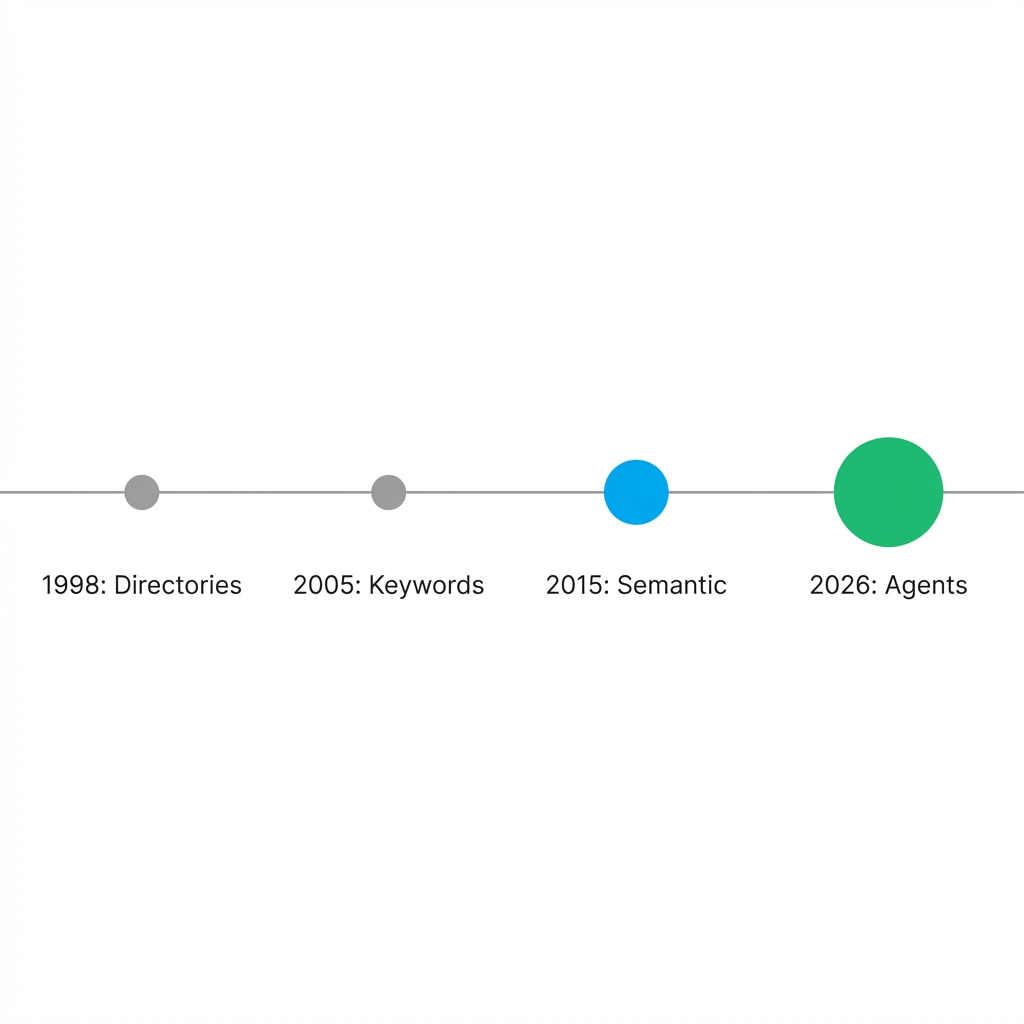
Era 1: The Directory Era (1994-1998)
| Characteristic | Details |
|---|---|
| Dominant Player | Yahoo! Directory |
| User Behavior | Browse hierarchical categories |
| Discovery Method | Human-curated topic trees |
| Marketing Strategy | Get listed in the right category |
| Key Metric | Directory placement |
Yahoo employed humans to manually organize the web into categories. Users browsed like they were walking through a library. If you weren't categorized, you didn't exist.
Era 2: The Keyword Era (1998-2012)
| Characteristic | Details |
|---|---|
| Dominant Player | Google Search |
| User Behavior | Type keyword queries |
| Discovery Method | Algorithmic matching of keywords to pages |
| Marketing Strategy | Keyword optimization, link building |
| Key Metric | Keyword rankings |
Google's PageRank algorithm revolutionized discovery. Instead of browsing categories, users typed keywords and received ranked results. SEO as we know it was born. The better you matched keywords and accumulated authority signals, the higher you ranked.
Era 3: The Semantic Era (2012-2023)
| Characteristic | Details |
|---|---|
| Dominant Player | Google Knowledge Graph, Voice Assistants |
| User Behavior | Ask questions, expect direct answers |
| Discovery Method | Understanding entities and intent, not just keywords |
| Marketing Strategy | Schema markup, featured snippets, Answer Engine Optimization |
| Key Metric | SERP features, Position Zero |
Google's Knowledge Graph (2012) marked a shift from "strings to things." The search engine began understanding that "Apple" could mean a fruit or a company depending on context. Voice assistants like Siri and Alexa normalized conversational queries. Answer Engine Optimization emerged as users expected direct answers rather than links.
Era 4: The Agentic Era (2024+)
| Characteristic | Details |
|---|---|
| Dominant Players | ChatGPT, Claude, Gemini, Perplexity, Multi-modal agents |
| User Behavior | Delegate tasks, not just queries |
| Discovery Method | AI synthesizes information and takes action on behalf of users |
| Marketing Strategy | Generative Engine Optimization, API readiness, transactional capability |
| Key Metric | AI Visibility Score, Agent Conversion Rate |
We've now entered the Agentic Era. Users aren't just searching—they're delegating. The AI isn't just returning information—it's taking actions. This changes everything about how brands need to position themselves. For enterprises, this shift extends beyond marketing to transforming how market research itself is conducted.
The Paradigm Shift: "Finding" vs. "Doing"
Here's the core insight that separates leaders from laggards: the value equation has completely flipped.
The Old Value Equation
Brand Value = Ability to be FOUND when user searches
If you ranked #1 for "best CRM software," you won. Users clicked your link, read your pitch, and hopefully converted.
The New Value Equation
Brand Value = Ability to be SELECTED when agent acts
Now an agent synthesizes information from dozens of sources and makes a recommendation. Ranking #1 on Google matters far less than being the answer the AI chooses to give.
What This Means Practically
Old Funnel:
Awareness → Interest → Consideration → Purchase
   ↓          ↓           ↓              ↓
 (30 days)  (7 days)   (3 days)      (1 day)
Agent-Compressed Funnel:
Intent → Agent Research → Agent Recommendation → Purchase
   ↓           ↓                  ↓                  ↓
(instant)  (30 seconds)     (10 seconds)        (1 click)
The agent compresses a 30-day consideration journey into minutes. Your brand either gets selected on that first pass, or you never enter the consideration set at all.
What Agents Actually Want From Your Website
Agents are software programs. They're goal-oriented, efficiency-maximizing, and intolerant of friction. Understanding their "preferences" is crucial.
The Agent Preference Matrix
| Agent Want | Why They Want It | How to Provide It |
|---|---|---|
| Structured Data | Eliminates ambiguity | Comprehensive Schema markup |
| Clear Pricing | Enables comparison | Public pricing pages with Offer schema |
| Transactional APIs | Enables action | Documented APIs, booking widgets |
| Verifiable Claims | Reduces hallucination risk | Citations, third-party reviews |
| Fast Response | Respect for compute limits | Sub-second page loads, lightweight pages |
| Machine-Readable Content | Efficient parsing | RAG-optimized content structure |
Things Agents Hate (And Will Route Around)
- "Contact Sales" for pricing: Agents can't negotiate. They skip you.
- JavaScript-heavy SPAs without SSR: Many agents see blank pages.
- PDF-only content: Harder to parse, often skipped.
- Login walls: Agents can't authenticate (usually).
- Video-only explanations: Most agents can't watch videos (yet).
- Vague marketing speak: "Best-in-class solution" tells an agent nothing.
The Death of the Marketing Funnel (As We Knew It)
The traditional marketing funnel assumes a human user who progresses through stages of awareness and consideration. But when an agent handles the discovery process, several stages collapse or disappear entirely.
What's Changing
| Traditional Stage | Agent Era Equivalent |
|---|---|
| Awareness | Brand presence in training data |
| Interest | Agent retrieves your content as relevant |
| Consideration | Agent includes you in comparison |
| Decision | Agent recommends you over alternatives |
| Purchase | Agent completes transaction (or hands off to human) |
What This Means for Marketing Teams
- Top-of-funnel content becomes less valuable (agents synthesize, not click)
- Bottom-of-funnel optimization becomes critical (transactional readiness)
- Middle-funnel nurturing may become irrelevant (agents compress consideration)
- Brand building shifts from impressions to entity strength (how well the AI "knows" you)
The New Success Metrics
| Old Metric | Problem in Agent Era | New Metric |
|---|---|---|
| Website Traffic | Agents don't "browse" | Agent-Referred Conversions |
| Time on Site | Agents are fast | Transaction Completion Rate |
| Pages per Session | Agents are efficient | API Request Volume |
| Bounce Rate | Agents leave after getting data | Data Extraction Success |
| Form Fills | Agents prefer APIs | API Signups |
Agent-Readiness Audit: A Comprehensive Checklist
Use this checklist to assess and improve your agent-readiness:
Technical Infrastructure
- [ ] API Documentation: Do you have a public API that allows agents to interact with your data?
- [ ] Schema Markup Depth: Does every important page have Product, FAQ, Organization, Service schema?
- [ ] Robots.txt Optimization: Are AI crawlers allowed to access your content?
- [ ] Page Speed: Do all pages load in under 2 seconds?
- [ ] Server-Side Rendering: Is content visible without JavaScript execution?
Content Structure
- [ ] Fact Density: Does every page contain specific, quotable facts?
- [ ] Comparison Tables: Can an agent easily compare your features/pricing to competitors?
- [ ] FAQ Coverage: Are common purchase questions answered with FAQ schema?
- [ ] Self-Contained Paragraphs: Is each paragraph understandable without context from others?
- [ ] Definition Clarity: Is it obvious what you sell in the first 100 words of key pages?
Transactional Capability
- [ ] Public Pricing: Can an agent see your exact prices without human negotiation?
- [ ] Availability Data: Is product/service availability accessible in real-time?
- [ ] Booking Integration: Can an agent schedule a demo or purchase through an API?
- [ ] Policy Transparency: Are shipping, returns, and refund policies machine-readable?
- [ ] Stock Status: For e-commerce, is inventory data accessible?
Trust & Verification
- [ ] Third-Party Reviews: Do you have presence on review platforms (G2, Capterra, Trustpilot)?
- [ ] Case Studies: Are specific results published (not generic testimonials)?
- [ ] Entity Verification: Is your brand verified on major platforms?
- [ ] Security Credentials: Are trust badges and certifications prominent?
- [ ] Author Expertise: Is E-E-A-T (Experience, Expertise, Authoritativeness, Trust) demonstrated?
Industry-Specific Agent Optimization
Different industries require different agent optimization strategies:
SaaS / B2B Software
Primary agent task: Compare options, recommend based on requirements Critical elements:
- Feature comparison tables with specifics (not "enterprise-grade")
- Integration lists (specific APIs supported)
- Per-seat pricing visible, not "contact sales"
- Implementation timeline estimates
- Read more: SaaS GEO Playbook
E-Commerce / Retail
Primary agent task: Find product matching criteria, verify availability, purchase Critical elements:
- Product schema with GTINs
- Real-time inventory status
- Semantic product attributes (material, color, size, occasion)
- Shipping speed and cost
- Review aggregation
- Read more: AI Commerce Optimization
Travel & Hospitality
Primary agent task: Plan itinerary, check availability, book Critical elements:
- Real-time availability APIs
- Pricing with clear dates and conditions
- Amenity lists in structured data
- Location data with context
- Cancellation policies in machine-readable format
Local Services
Primary agent task: Find nearby option, verify quality, initiate contact Critical elements:
- NAP consistency across platforms
- Service area definitions
- Real-time availability/scheduling
- LocalBusiness schema
- Read more: Local AI Optimization
Case Study: How a Travel Site 5x'd Agent-Driven Bookings
Here's a real example of agent optimization in action (details anonymized):
The Company: Mid-size boutique hotel booking platform The Problem: 0.3% of bookings came from AI-assisted channels
Diagnosis:
- No API for real-time availability checks
- Prices were dynamically loaded via JavaScript (invisible to crawlers)
- Amenity information was scattered across multiple pages
- No structured data for hotels or rooms
Intervention (4-month project):
| Month 1 | Month 2 | Month 3 | Month 4 |
|---|---|---|---|
| Built public availability API | Added Hotel and LodgingBusiness schema | Implemented SSR for all pricing | Launched "AI Partner" program |
| Consolidated amenity data | Created FAQ sections for each property | Added OfferShippingDetails for checkout | Published llms.txt manifest |
| Fixed robots.txt | Optimized Core Web Vitals | Integrated with 3 AI travel assistants | Monitored and iterated |
Results:
- AI-assisted bookings: 0.3% → 4.7% of total (15x increase)
- Average order value from AI channels: 23% higher than direct
- Booking completion rate for AI-referred users: 31% (vs 2.4% site average)
- Featured in ChatGPT "best boutique hotels" answers for 7 major cities
Key Insight: The higher conversion rate from AI channels isn't surprising—agents pre-qualify users. By the time a human is handed off, they've already been matched to the right product at the right price.
The Technology Stack for Agent-Ready Brands
Building for the agent economy requires specific technical capabilities:
Core Infrastructure
| Component | Purpose | Example Tools |
|---|---|---|
| CDN with Edge Computing | Fast global response | Cloudflare, Fastly, Vercel |
| Headless CMS | Content structured for APIs | Sanity, Contentful, Strapi |
| API Gateway | Managed API access | Kong, AWS API Gateway |
| Data Warehouse | Unified product/service data | Snowflake, BigQuery |
| Schema Generator | Automated structured data | Yext, custom solutions |
AI-Specific Components
| Component | Purpose | Example Tools |
|---|---|---|
| AI Visibility Monitoring | Track citation frequency | AICarma, manual testing |
| Semantic Content Optimizer | Ensure RAG-friendly structure | Clearscope, MarketMuse, Frase |
| Entity Management | Maintain knowledge graph presence | Yext, domain expertise |
| Conversational Analytics | Track agent interactions | Custom event logging |
Integration Priorities
If budget is limited, prioritize in this order:
- Schema markup automation (immediate impact)
- API for core transactional data (enables action)
- AI visibility monitoring (enables measurement)
- Content structure optimization (improves retrieval)
Preparing Your Team for the Agent Economy
The shift to agent-optimized marketing requires new skills and mindsets:
Skills Your Team Needs
| Skill | Why It Matters | How to Develop |
|---|---|---|
| API Literacy | Understanding how agents interact with data | Basic API courses, hands-on projects |
| Structured Data Expertise | Schema markup is foundational | Schema.org training, certification |
| LLM Understanding | Knowing how AI processes content | Prompt engineering, model testing |
| Semantic Content Strategy | Writing for retrieval | RAG optimization training |
| Cross-Model Testing | Visibility varies by platform | Systematic testing processes |
Organizational Changes
- Marketing + Engineering Alignment: Agent optimization requires close collaboration
- New KPIs: Replace traffic metrics with agent-relevant ones
- Content Review Process: Add "agent quotability" as review criteria
- Budget Reallocation: Shift from awareness to conversion enablement
Culture Shift
The hardest change is philosophical. Teams must accept that:
- The user might never visit your website (and that's okay)
- Search rankings are becoming less relevant (agents synthesize, not rank)
- Transaction is the new first impression (agents recommend buyers, not browsers)
FAQ
Will AI agents really buy things for people?
Yes, and it's already happening. The technology exists today. The barrier is trust, not capability. As "human-in-the-loop" confirmation systems improve, routine purchases (groceries, SaaS subscriptions, travel bookings) will increasingly be delegated. By 2027, major analyst firms predict 15-20% of e-commerce transactions will involve AI agent assistance.
How do I optimize for Task Completion if my product requires human consultation?
Focus on reducing the friction for agents to schedule that consultation. Offer transparent calendar availability, clear consultation pricing (if applicable), and FAQ content that pre-answers common pre-consultation questions. The agent's job shifts from "complete transaction" to "qualify and schedule" but the optimization principles remain similar.
What happens to my website traffic in an agent-dominated world?
Traffic will likely decrease in volume but increase dramatically in quality. You'll get fewer "browsers" and more "ready-to-buy" users (or agents acting on their behalf). Reframe success metrics around conversion rate and transaction value rather than visitor counts.
Should I build custom integrations with specific AI assistants?
Eventually, yes. Major platforms (OpenAI, Google, Amazon) are creating partner ecosystems for preferred vendors. Early integration can provide competitive advantage. Start by ensuring you're generally agent-optimized, then pursue strategic integrations based on where your customers are using AI tools.
How do I measure ROI of agent optimization?
Attribution is tricky because agents often don't leave traditional referrer data. Implement these measurement strategies:
- Create unique landing pages for agent-referred traffic
- Add "How did you hear about us?" surveys with "AI/ChatGPT" options
- Monitor branded search volume increases (AI often drives subsequent direct searches)
- Track API request logs to see agent interaction patterns
- Compare conversion rates segmented by traffic source
Is this just hype, or is the shift really happening?
The shift is real and accelerating. Consider: ChatGPT reached 100 million users faster than any product in history. Perplexity processes over 10 million queries per day. Google has embedded AI Overviews into billions of searches. The user behavior change is happening whether brands adapt or not—the question is whether you'll be positioned to capitalize on it.