
Entity SEO: How to Build Your Brand's Presence in the Knowledge Graph
Last Updated: March 12, 2025
Quick experiment: Go to ChatGPT and ask it to describe your company.
If you're like most businesses, one of three things happened:
- The AI described you accurately (congratulations—you have strong entity presence)
- The AI described you vaguely or partially incorrectly (you need entity work)
- The AI said it doesn't have information about you (your entity barely exists)
Here's the uncomfortable truth: to an AI, you're not a website. You're an entity. And if your entity is weak, confused, or nonexistent, no amount of keyword optimization will save you.
In 2012, Google famously announced the Knowledge Graph with the phrase "things, not strings." A decade later, Large Language Models have taken this concept to its logical conclusion. ChatGPT, Claude, and Gemini don't just match your keywords—they form mental models of entities and their relationships.
"Apple" isn't just a 5-letter word to these systems. It's a Company (entity type) with Attributes (founder: Steve Jobs, products: iPhone, Mac) and Relationships (competitor: Samsung, parent of: Beats).
If you want AI to understand your brand correctly, recommend you confidently, and never hallucinate incorrect facts about you, you need to master Entity SEO.
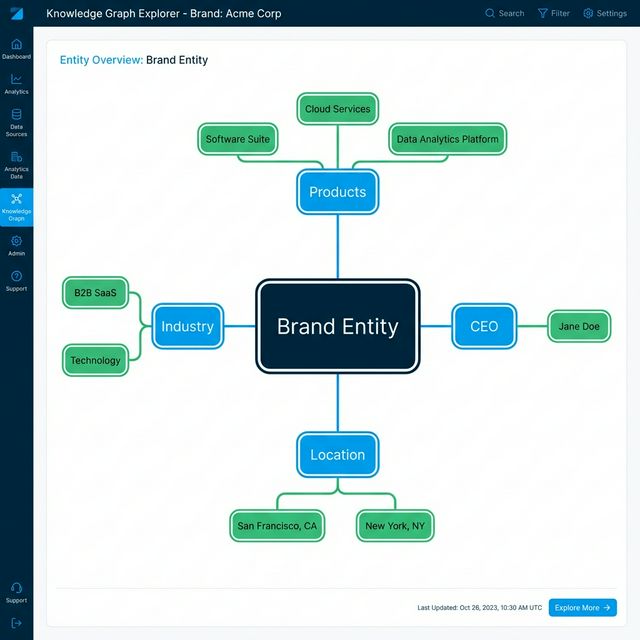
Table of Contents
- Keywords vs. Entities: The Fundamental Shift
- How AI Understands Entities
- The Anatomy of a Strong Entity
- Building Your Entity: A Strategic Framework
- The "sameAs" Strategy: Connecting Your Digital Identity
- N-A-P Consistency: The Foundation
- Knowledge Graph Presence: The Holy Grail
- Measuring Entity Strength
- Fixing Entity Contamination
- FAQ
Keywords vs. Entities: The Fundamental Shift
The Keyword Era (Dying)
In traditional SEO, the game was keyword matching:
- User searches "best CRM software"
- You optimize page for "best CRM software"
- Google matches the strings
- You rank
This still matters for traditional search, but it's increasingly insufficient.
The Entity Era (Rising)
In modern AI systems, the game is entity understanding:
- User asks "What CRM would work best for a 50-person sales team?"
- AI retrieves information about CRM entities (Salesforce, HubSpot, Pipedrive)
- AI evaluates attributes and relationships of each entity
- AI recommends based on entity understanding, not keyword matching
| Keyword SEO | Entity SEO |
|---|---|
| Optimize for strings | Optimize for concepts |
| Target specific queries | Build comprehensive understanding |
| Page-focused | Entity-focused |
| Measured by rankings | Measured by AI visibility |
| Backlinks as authority | Knowledge Graph as authority |
Why This Matters
Keyword optimization: "We rank #1 for 'project management software'" Entity optimization: "AI understands we're the project management solution best suited for creative agencies because of our Figma integration, visual workflows, and design-focused interface"
The second approach wins in the AI era because it maps to how users actually ask questions.
How AI Understands Entities
Large Language Models build entity understanding through three mechanisms:
1. Training Data Associations
During training, LLMs absorb millions of mentions of entities across the web. They learn associations:
"Salesforce" frequently appears with:
- "CRM", "sales automation", "enterprise"
- "Marc Benioff" (founder)
- "Dreamforce" (conference)
- "Einstein AI", "Data Cloud" (products)
These associations form the AI's initial understanding of the Salesforce entity.
2. Knowledge Graph Integration
Some AI systems (especially Google's) are connected to structured knowledge bases like Wikidata. These provide:
- Canonical entity identifiers
- Verified attributes (founding date, HQ location)
- Explicit relationships (founder, owns, competitor of)
3. Schema Markup Parsing
When AI crawls your site, Schema.org markup provides explicit entity definitions:
{
  "@type": "Organization",
  "name": "AICarma",
  "foundingDate": "2023",
  "founder": {"@type": "Person", "name": "..."},
  "sameAs": ["https://linkedin.com/company/aicarma"]
}
This structured data is treated as higher confidence than inferred data from unstructured text.
The Anatomy of a Strong Entity
What separates a strong entity (Apple, Nike, Salesforce) from a weak one (most B2B startups)? Several key factors:
Core Entity Attributes
| Attribute | Example | How to Establish |
|---|---|---|
| Canonical Name | "Salesforce" not "SFDC" | Consistent naming everywhere |
| Entity Type | Organization: Software Company | Schema Organization + industry |
| Defining Description | "Cloud-based CRM platform" | Repeated consistently across sources |
| Founding Information | 1999, San Francisco | Wikipedia, Crunchbase, Schema |
| Key People | Marc Benioff (CEO/Founder) | Person Schema, LinkedIn, news |
| Products/Services | Sales Cloud, Service Cloud | Product Schema, documentation |
Entity Relationships
Strong entities have clear relationships to other entities:
HubSpot
├── Founder: Brian Halligan
├── Competitor: Salesforce, Zoho
├── Category: CRM, Marketing Automation
├── Integration: Gmail, Slack, Shopify
└── Customer: Dropbox, Casper, Trello
These relationships help AI understand context—when to recommend you versus alternatives.
Entity Confidence
AI systems have varying levels of confidence in their entity knowledge. High-confidence entities:
- Appear in authoritative sources (Wikipedia, major news)
- Have consistent information across sources
- Are verified in knowledge graphs
- Have rich structured data on their own sites
Low-confidence entities get hedged language: "According to their website..." vs "HubSpot is..."
Building Your Entity: A Strategic Framework
Phase 1: Foundation (Core Identity)
Objective: Establish your canonical entity definition
-
Define your core description (1-2 sentences that should appear everywhere):
- What you are (entity type)
- What you do (primary offering)
- Who you serve (target)
Example: "AICarma is an AI visibility monitoring platform that helps B2B companies track and optimize their presence in ChatGPT, Claude, and Gemini."
-
Standardize your name: Pick one canonical version and use it everywhere. Not "AICarma Inc." in some places and "AI Carma" in others.
-
Establish founding facts: Year founded, location, founders. Get these into structured data and profiles.
Phase 2: Presence (Verification Sources)
Objective: Create presence in authoritative sources
| Source | Priority | Why It Matters |
|---|---|---|
| Crunchbase | Critical | Heavily weighted in training data |
| LinkedIn Company Page | Critical | Cross-references identity |
| Google Business Profile | High | Powers Knowledge Panel |
| Wikipedia | High (if eligible) | Highest authority source |
| Wikidata | High | Structured knowledge graph |
| Industry Directories | Medium | G2, Capterra, industry-specific |
| News Coverage | Medium | Contextual mentions |
Phase 3: Connections (Relationship Mapping)
Objective: Establish relationships to strengthen context understanding
Use Schema sameAs to connect your website to all verified profiles:
"sameAs": [
  "https://www.linkedin.com/company/yourcompany",
  "https://www.crunchbase.com/organization/yourcompany",
  "https://twitter.com/yourcompany",
  "https://g2.com/products/yourcompany"
]
Create explicit mentions of relationships:
- Founders/team members (Person entities)
- Partnerships (Organization entities)
- Integration partners (mentions their entities)
- Industry categories (CategoryCode)
Phase 4: Reinforcement (Ongoing)
Objective: Continuously strengthen entity signals
- Ensure all new content references your canonical entity name
- Keep all profiles updated with consistent information
- Generate ongoing authoritative mentions (press, podcasts, guest posts)
- Monitor for and correct entity contamination
The "sameAs" Strategy: Connecting Your Digital Identity
The sameAs property in Schema.org is perhaps the most underutilized power tool in Entity SEO. It explicitly tells AI: "These different profiles are all the SAME entity."
Without sameAs
AI sees:
- AICarma (your website)
- AICarma (LinkedIn company page)
- AICarma (Crunchbase profile)
- 🤷 Are these the same thing?
With sameAs
AI understands:
- These are all the same entity
- Combine the signals from all sources
- Higher confidence in entity understanding
Implementation
On your homepage, add Organization Schema with comprehensive sameAs:
{
  "@context": "https://schema.org",
  "@type": "Organization",
  "name": "AICarma",
  "@id": "https://aicarma.io/#organization",
  "url": "https://aicarma.io",
  "sameAs": [
    "https://www.linkedin.com/company/aicarma",
    "https://www.crunchbase.com/organization/aicarma",
    "https://twitter.com/aicarma",
    "https://www.g2.com/products/aicarma",
    "https://www.facebook.com/aicarma",
    "https://github.com/aicarma"
  ]
}
Which Platforms to Include
| Platform | Include in sameAs? | Why |
|---|---|---|
| Always | High authority, widely crawled | |
| Crunchbase | Always | Critical for B2B/startups |
| Twitter/X | Always | Frequently in training data |
| If active | Useful for consumer brands | |
| G2/Capterra | For SaaS | Important for software entities |
| Wikipedia | If exists | Highest authority |
| GitHub | If relevant | For tech companies |
| YouTube | If channel exists | For video presence |
N-A-P Consistency: The Foundation
N-A-P stands for Name, Address, Phone—the basic identity triad. Inconsistency here creates entity confusion.
The Problem with Inconsistency
| Source | Company Name | Result |
|---|---|---|
| Website | AICarma Inc. | ❌ Confusion |
| AICarma | ❌ Different? | |
| Crunchbase | AI Carma | ❌ Third entity? |
| G2 | AiCarma | ❌ Fourth entity? |
AI systems may treat these as different entities, fragmenting your authority.
The N-A-P Audit
- List all profiles and directories where your brand appears
- Extract the exact NAP from each
- Identify inconsistencies
- Update to canonical version everywhere
Beyond Basic NAP
For B2B companies, extend to include:
- Founding date (must match everywhere)
- Core description (should be highly similar)
- Key product names (standardized across platforms)
- Category/industry designations
Knowledge Graph Presence: The Holy Grail
If your company appears in Google's Knowledge Panel when you search for it, you've achieved significant entity presence. This panel is powered by the Knowledge Graph—Google's structured database of real-world entities.
How to Get a Knowledge Panel
- Wikipedia: If you meet notability criteria, a Wikipedia article triggers panels
- Wikidata: Even without Wikipedia, Wikidata entries can power panels
- Consistent structured data: Comprehensive Schema across your site
- Authoritative mentions: News coverage, major publications
If You Have a Panel
Claim it: Go to Google Business Profile and verify ownership. This allows you to suggest edits.
Audit for accuracy: Check all facts—founding date, location, description. Report inaccuracies.
If You Don't Have a Panel Yet
Focus on:
- Building Crunchbase profile comprehensively
- Getting coverage in mainstream news (not just press releases)
- Implementing rich Schema on your site
- Creating Wikidata entry (doesn't require notability)
Measuring Entity Strength
How do you know if your entity-building efforts are working?
Direct Tests
The ChatGPT Description Test: Ask: "Describe [Your Company]"
- Accurate & detailed = Strong entity
- Vague or hedged = Weak entity
- "I don't have information" = Barely exists
The Comparison Test: Ask: "Compare [Your Company] to [Competitor]"
- Detailed comparison = Strong entities
- One-sided (competitor only) = Your entity is weaker
- Confused attributes = Entity contamination
Quantitative Indicators
| Metric | How to Measure | Good Sign |
|---|---|---|
| Knowledge Panel | Google your brand name | Panel appears |
| Wikipedia | Search Wikipedia | Article exists |
| Wikidata | Search Wikidata | Entry with properties |
| Branded Search Volume | Google Search Console | Growing over time |
| AI Visibility Score | AICarma or manual testing | High mention rate |
Fixing Entity Contamination
Entity contamination occurs when AI has incorrect information about your brand—wrong products, wrong pricing, wrong founders, etc.
Common Causes
- Outdated information: Your 2019 pricing is still in training data
- Competitor confusion: Similar names cause attribute mixing
- Inconsistent sources: Conflicting information across profiles
- Training data errors: Errors in sources used for training
The Fix: Signal Overwhelming
You can't delete incorrect information from AI training data. But you can overwhelm it with correct signals:
- Update all profiles to correct information
- Add rich Schema with verified facts
- Get new coverage that includes correct information
- Create dedicated FAQ content addressing commonly-hallucinated facts
- Implement llms.txt with curated correct information
Prevention
- Audit all public profiles quarterly
- Never let information go stale on any platform
- Respond to incorrect information in reviews/mentions
- Monitor AI responses for drift
FAQ
Do I need a Wikipedia page?
It helps significantly, but it's not required. Wikidata entries, comprehensive Crunchbase profiles, and strong Schema markup can establish entity presence without Wikipedia. However, if you meet notability criteria, a Wikipedia article dramatically increases Knowledge Graph presence.
How does Entity SEO affect Voice Search?
Voice assistants (Siri, Alexa, Google Assistant) rely heavily on the Knowledge Graph. When someone asks "Who founded [Your Company]?", the answer comes from your entity attributes, not from web page rankings. Strong entity presence = accurate voice search answers.
Can I fix a "hallucinated" entity description?
If AI incorrectly describes your company (wrong industry, wrong products), you need to flood the ecosystem with correct signals. Update all profiles, implement detailed Schema, get fresh press coverage with correct information. It takes time—3-12 months—for new training cycles to incorporate corrections.
What if my company has a common name?
This is an entity disambiguation challenge. Strategies include:
- Always using descriptors ("Acme Software" not just "Acme")
- Building strong sameAs connections that create a unique signature
- Targeting specific attribute combinations that differentiate you
- Considering brand evolution if confusion is severe
Does entity presence help traditional SEO too?
Yes. Google increasingly uses entity understanding in traditional search. Sites with strong entity presence:
- More likely to get Knowledge Panels
- Better chance at featured snippets
- Improved E-E-A-T signals
- Stronger brand queries performance