
What Is AI Visibility Score? The Complete Guide to Share of Model
Last Updated: July 22, 2025
For two decades, marketing leaders obsessed over a metric called Share of Voice (SOV)—what percentage of the conversation your brand owned in a category. You'd track mentions, impressions, and rankings to understand your market presence.
That metric is becoming obsolete.
In the AI era, there's a new metric that matters more: Share of Model (SoM), or what we call your AI Visibility Score. It answers a deceptively simple question: When users ask AI about your category, how often does the AI mention you? For enterprise organizations, this shift is driving fundamental changes in how corporate reputation is managed.
This isn't a theoretical concern. By 2027, analysts predict that 30-50% of product research will happen through AI assistants. If your brand has a 5% Share of Model while your competitor has 40%, you're losing the future of discovery.
Let's understand this metric—and more importantly, learn how to improve it.
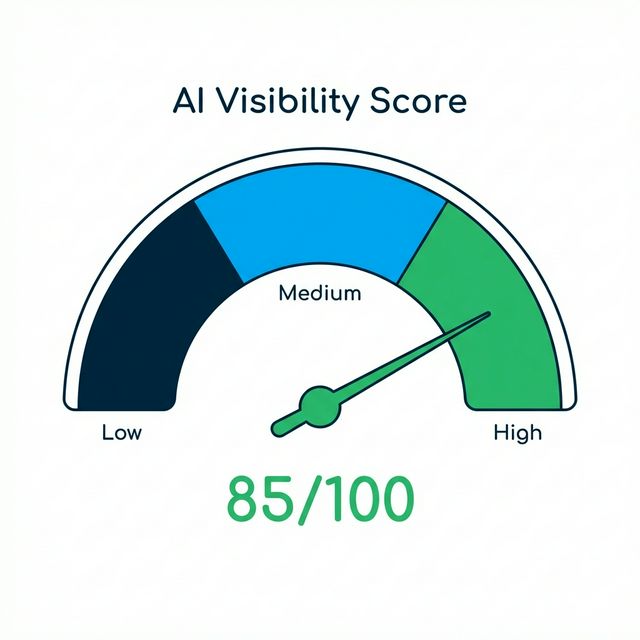
Table of Contents
- From Share of Voice to Share of Model
- Why Traditional Rankings Don't Translate
- How Share of Model Is Calculated
- The Visibility Score Framework
- Cross-Model Variance: Why GPT and Claude Disagree
- How to Measure Your Visibility Score
- Benchmarking: What's a Good Score?
- Improving Your Visibility Score
- The Visibility Dashboard: Metrics That Matter
- FAQ
From Share of Voice to Share of Model
The Old World: Share of Voice
In traditional marketing, Share of Voice measured your presence relative to competitors:
Your Share of Voice = Your Mentions / Total Category Mentions
You'd track this across channels—search rankings, social mentions, press coverage, ad impressions. Higher SOV generally correlated with higher market share.
The New World: Share of Model
Share of Model applies the same concept to AI recommendations:
Your Share of Model = Times You're Mentioned by AI / Total Relevant AI Responses
When someone asks ChatGPT "What are the best CRM tools?", one of two things happens:
- You're mentioned (you have visibility)
- You're not mentioned (you're invisible)
Your Share of Model is the percentage of relevant prompts where you appear.
The Crucial Difference
| Share of Voice | Share of Model |
|---|---|
| Measured across many touchpoints | Measured across AI responses |
| Additive (more channels = more voice) | Winner-take-most (AI recommends top options) |
| Influenced by ad spend | Cannot be bought (yet) |
| Relatively stable | Highly volatile |
| Deterministic measurement | Probabilistic measurement |
Why Traditional Rankings Don't Translate
Here's the frustrating reality: you can rank #1 on Google and have 0% visibility in ChatGPT.
Case Study: The Invisible Market Leader
Consider a real scenario (anonymized):
- Company A: Ranked #1 for "best project management software" on Google
- Company B: Ranked #5 for the same keyword
When we asked ChatGPT "What's the best project management software?":
- Company A: Mentioned 12% of the time
- Company B: Mentioned 67% of the time
How is this possible? Because SEO and AI visibility operate on completely different logic.
Why Rankings ≠ AI Visibility
| Factor | SEO Ranking | AI Visibility |
|---|---|---|
| Data Source | Live web crawl | Training data + RAG |
| Authority Signal | Backlinks | Entity presence, training data weight |
| Relevance Signal | Keyword matching | Semantic understanding |
| Updates | Real-time | Frozen training + periodic updates |
| Personalization | Location, history | Model temperature (randomness) |
This disconnect explains why many market leaders suffer from Invisible Brand Syndrome—dominating traditional search while barely existing in AI recommendations.
How Share of Model Is Calculated
AI visibility isn't a single number—it's a distribution across multiple factors:
The Core Formula
Visibility Score = (Mention Frequency × Sentiment Weight) + Position Bonus
Where:
- Mention Frequency: % of prompts where you appear
- Sentiment Weight: Positive mentions count more than neutral/negative
- Position Bonus: Being recommended first > being mentioned last
Detailed Breakdown
| Component | What It Measures | Weight |
|---|---|---|
| Mention Rate | Are you mentioned at all? | 50% |
| Recommendation Rate | Are you specifically recommended? | 20% |
| Position | Where in the response do you appear? | 15% |
| Sentiment | Is the mention positive? | 10% |
| Accuracy | Is the information correct? | 5% |
Example Calculation
Prompt: "What's the best email marketing platform?"
| Run | Mentioned? | Recommended? | Position | Sentiment |
|---|---|---|---|---|
| 1 | Yes | Yes | 1st | Positive |
| 2 | Yes | No | 3rd | Neutral |
| 3 | No | No | - | - |
| 4 | Yes | Yes | 2nd | Positive |
| 5 | Yes | No | 4th | Positive |
Mention Rate: 4/5 = 80% Recommendation Rate: 2/5 = 40% Average Position: 2.5 Sentiment Score: 4/4 positive = 100%
The Visibility Score Framework
We use a 0-100 scoring framework to normalize across different query types:
Score Interpretation
| Score | Category | What It Means |
|---|---|---|
| 0-10 | Invisible | AI doesn't know you or doesn't trust you |
| 10-30 | Weak Presence | You're occasionally mentioned, but not recommended |
| 30-50 | Moderate Presence | Regular mentions, sometimes recommended |
| 50-70 | Strong Presence | Frequently recommended for relevant queries |
| 70-90 | Category Leader | First or second recommendation most of the time |
| 90-100 | Dominant | Default recommendation for the category |
Industry Benchmarks
| Industry | Average Top Player Score | Average Score |
|---|---|---|
| CRM | 72 (Salesforce, HubSpot) | 15 |
| Email Marketing | 68 (Mailchimp) | 18 |
| Project Management | 65 (Asana, Monday) | 14 |
| Cloud Infrastructure | 85 (AWS, Azure, GCP) | 8 |
| Design Tools | 81 (Figma, Adobe) | 12 |
Most industries show a massive gap between the top 3-5 players and everyone else.
Cross-Model Variance: Why GPT and Claude Disagree
Your visibility score isn't consistent across AI platforms. Each model has different training data, different biases, and different recommendation patterns.
Example Variance
| Brand | ChatGPT | Claude | Gemini | Perplexity |
|---|---|---|---|---|
| Brand A | 65% | 42% | 58% | 71% |
| Brand B | 23% | 67% | 31% | 29% |
| Brand C | 45% | 38% | 62% | 44% |
Why does this happen?
-
Training Data Differences: ChatGPT, Claude, and Gemini are trained on overlapping but different datasets. Your brand might be well-represented in one corpus but not others.
-
Retrieval Pipeline Differences: Each system uses different RAG approaches. Perplexity relies heavily on live search; Claude Pro may use different sources than Claude.
-
Model Personality: Each model has slight "personality" biases in how it frames recommendations.
Implications
You need to track visibility across multiple models:
- Don't assume GPT visibility = overall visibility
- Different user demographics prefer different models
- Optimize for portfolio coverage, not just one winner
This is why multi-model monitoring platforms aggregate data from 10+ LLMs into unified metrics—a single dashboard view of your true cross-model presence.
How to Measure Your Visibility Score
Method 1: Manual Testing (Starter)
Run these prompts across ChatGPT, Claude, and Gemini:
| Prompt Type | Example |
|---|---|
| Category Query | "What are the best [your category] tools?" |
| Use Case Query | "I need a tool for [use case]. What do you recommend?" |
| Comparison Query | "Compare [Your Brand] vs [Competitor]" |
| Brand Query | "Tell me about [Your Brand]" |
| Problem Query | "How do I solve [problem your product solves]?" |
Run each prompt 5-10 times (AI responses vary) and track:
- Were you mentioned?
- Were you recommended?
- What position?
- Was the information accurate?
Method 2: Automated Monitoring (Scale)
For systematic tracking, platforms like AICarma automate this process:
- Run thousands of prompts across 10+ AI models simultaneously
- Aggregate results into three core metrics: Visibility (mention frequency), Sentiment (tonal analysis), and Ranking (competitive position)
- Track trends over time with time-series analysis
- Benchmark against competitors in a real-time Visibility & Sentiment Matrix
Method 3: Synthetic Benchmarking (Advanced)
Create a standard battery of 50-100 prompts representing your target keywords and use cases. Run them weekly as a consistent benchmark.
Benchmarking: What's a Good Score?
Score Categories
| Query Type | "Good" Score | "Great" Score |
|---|---|---|
| Branded ("Tell me about X") | 70%+ | 90%+ |
| Category ("Best X tools") | 25%+ | 50%+ |
| Use Case ("X for Y use") | 20%+ | 40%+ |
| Comparison ("X vs Y") | 50%+ | 80%+ |
Competitive Framing
Your absolute score matters less than your relative position. If you're at 30% and your top competitor is at 35%, you're competitive. If they're at 70%, you have work to do.
Trend > Snapshot
A single visibility check is less valuable than a trend:
- Score increasing month-over-month = strategy working
- Score decreasing = losing ground
- Score stable while competitor increases = relative decline
Improving Your Visibility Score
Low visibility? Here's a prioritized improvement framework:
Quick Wins (1-2 Weeks)
| Action | Impact | Effort |
|---|---|---|
| Fix robots.txt to allow AI crawlers | High | Low |
| Add FAQ Schema to key pages | Medium | Low |
| Update Crunchbase/G2 profiles | Medium | Low |
| Make pricing public | Medium | Low |
Medium-Term (1-3 Months)
| Action | Impact | Effort |
|---|---|---|
| Build entity presence | High | Medium |
| Create comparison content | Medium | Medium |
| Implement comprehensive Schema | Medium | Medium |
| Launch Reddit presence | Medium | Medium |
Long-Term (3-12 Months)
| Action | Impact | Effort |
|---|---|---|
| Get press coverage in major outlets | High | High |
| Achieve Wikipedia/Wikidata listing | High | High |
| Publish original research | Medium | High |
| Become thought leader in category | High | High |
The Visibility Flywheel
Once you have visibility, maintaining it becomes easier:
- AI recommends you → Users try your product
- Users discuss you → More training data
- More training data → AI knows you better
- AI recommends you more → Repeat
The hard part is starting the flywheel. Initial investment yields compounding returns.
The Visibility Dashboard: Metrics That Matter
Set up a visibility dashboard tracking these metrics:
Primary Metrics
| Metric | Frequency | Target |
|---|---|---|
| Overall Visibility Score | Weekly | Increasing |
| Category Query Visibility | Weekly | Above competitors |
| Cross-Model Variance | Monthly | Narrowing gap |
| Sentiment Score | Monthly | >80% positive |
Secondary Metrics
| Metric | Frequency | Why It Matters |
|---|---|---|
| Branded Search Volume | Monthly | Indicates AI → direct interest |
| AI-Referred Traffic | Weekly | Measures actual clicks from AI |
| Mention Accuracy | Monthly | Catches hallucinations early |
| Position Distribution | Monthly | First > third matters |
Competitive Metrics
| Metric | How to Track |
|---|---|
| Share of Model vs Top 3 | Run same prompts, compare % |
| Visibility Gap Trend | Monthly comparison |
| Win/Loss on Head-to-Head | Comparison prompt analysis |
Platforms like AICarma visualize competitive positioning through a Visibility & Sentiment matrix, automatically placing brands into quadrants from "Low Performance" to "Leaders" so you can instantly see where you stand.
FAQ
What's a good AI Visibility Score for my brand?
For branded queries ("Tell me about [Your Brand]"), aim for 70%+ visibility—the AI should know who you are. For category queries ("Best CRM tools"), 25%+ is competitive, and 50%+ is excellent. Context matters: if you're a niche player in a category dominated by giants, 15% visibility might be a significant win.
Does my visibility score change between AI models?
Yes, significantly. You might have 60% visibility in ChatGPT but only 20% in Claude due to different training data and retrieval systems. Track across multiple models (ChatGPT, Claude, Gemini, Perplexity) and optimize for portfolio coverage rather than just one platform.
Can I pay to improve my AI Visibility Score?
Not directly—there's no "AI Ads" equivalent yet. Your visibility is earned through entity strength, training data presence, and technical optimization. This may change as AI companies explore monetization, but for now, visibility must be built, not bought.
How often should I measure my visibility?
Weekly for key category queries, monthly for comprehensive audits. AI model behavior can change with updates, so consistent monitoring catches both improvements and unexpected drops.
How does visibility relate to actual business results?
AI-recommended traffic typically converts at 2-3x the rate of traditional search traffic. Users who arrive via AI recommendation have been pre-qualified—the AI essentially did sales engineering for you. Track AI-referred traffic separately in analytics to measure true impact.