
AI Commerce: How to Optimize Product Feeds for ChatGPT and Google Shopping AI
Last Updated: November 25, 2025
Picture this: A user tells their AI assistant, "Find me running shoes for flat feet, under $150, with good arch support. I prefer Nike or Brooks, and I'm training for a marathon."
Within seconds, the AI evaluates hundreds of products, reads reviews, compares specifications, and returns a curated shortlist of 3-5 options. The user picks one and completes the purchase—all without visiting a single product listing page.
This is the future of e-commerce. Actually, it's the present. Google Shopping AI, Amazon's Rufus, and ChatGPT's shopping features are already changing how consumers discover and buy products.
For e-commerce brands and retailers, this creates both existential risk and massive opportunity. The brands that master AI commerce optimization will dominate the new product discovery landscape. Those that don't will fade into irrelevance.
Table of Contents
- The AI Shopping Revolution
- How AI Shopping Assistants Work
- Product Data: The Foundation of AI Commerce
- The GTIN Imperative
- Semantic Product Attributes
- Review Optimization for AI
- Structured Data for E-commerce
- Platform-Specific Optimization
- The AI Commerce Audit
- FAQ
The AI Shopping Revolution
E-commerce has gone through three discovery eras:
Era 1: Search-Based Discovery (1995-2015)
Users typed keywords, got product listings, browsed, compared, purchased.
Key success factors: SEO, paid search, marketplace optimization
Era 2: Feed-Based Discovery (2015-2023)
Google Shopping, Facebook Ads, and marketplaces used product feeds to show relevant products.
Key success factors: Feed optimization, bid strategy, marketplace presence
Era 3: AI-Assisted Discovery (2023+)
Users describe what they want in natural language. AI synthesizes information and recommends products.
Key success factors: Generative Engine Optimization, semantic product data, review presence
The Stakes
| User Behavior | E-commerce Impact |
|---|---|
| "Find running shoes" | AI curates options |
| Reads product specs | AI summarizes for them |
| Compares options | AI does the comparison |
| Checks reviews | AI synthesizes sentiment |
| Makes decision | AI recommends winner |
At every stage, AI is the intermediary. If your products don't optimize for AI consumption, they won't be recommended.
How AI Shopping Assistants Work
Understanding the technology helps you optimize for it:
The AI Shopping Pipeline
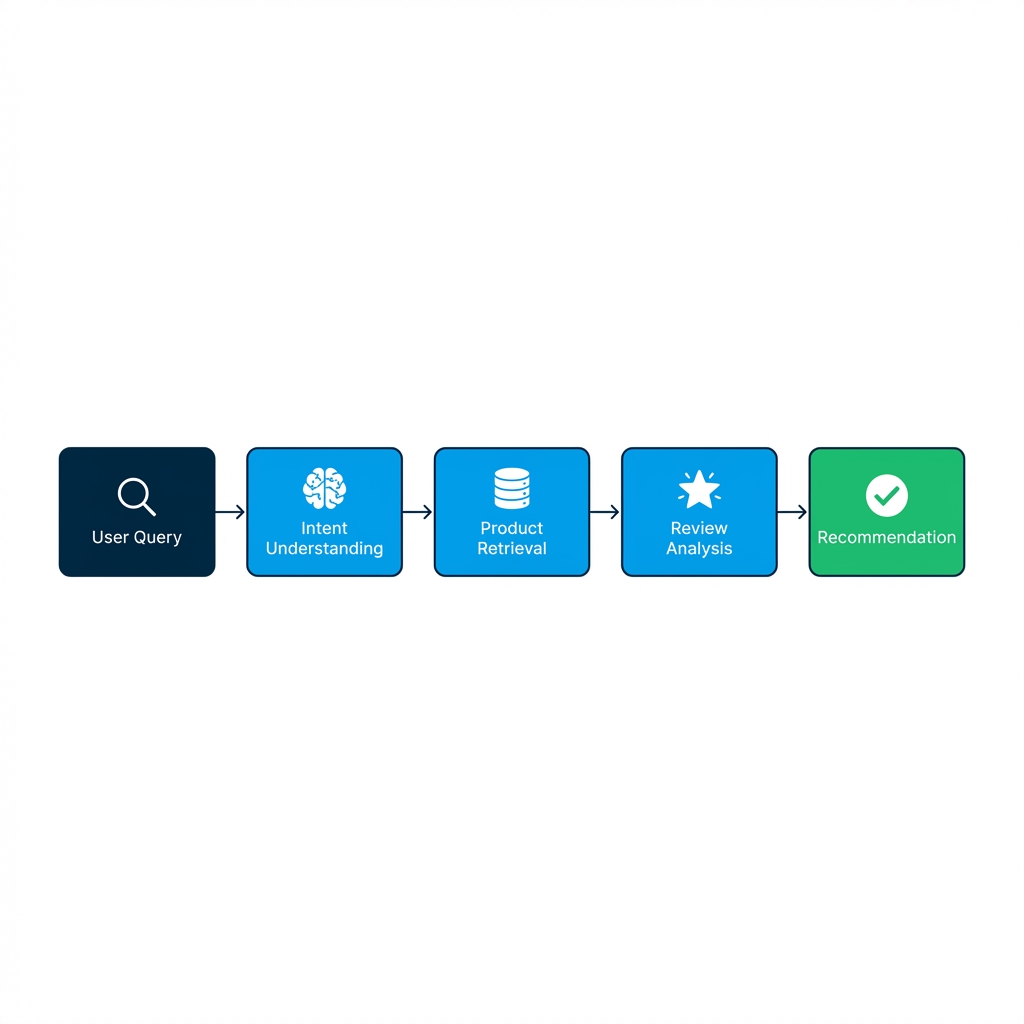
- Intent Understanding: AI parses user needs (product type, constraints, preferences)
- Product Retrieval: AI searches product databases/feeds for matches
- Feature Matching: AI compares product attributes to user requirements
- Review Analysis: AI assesses sentiment and trust signals
- Recommendation: AI selects and presents top options
What AI Needs from Your Products
| Need | How to Provide |
|---|---|
| Clear product type | Accurate categorization |
| Specific attributes | Detailed, structured data |
| Price and availability | Real-time feed data |
| Social proof | Reviews, ratings |
| Trust signals | Brand authority, certifications |
The Three Data Sources
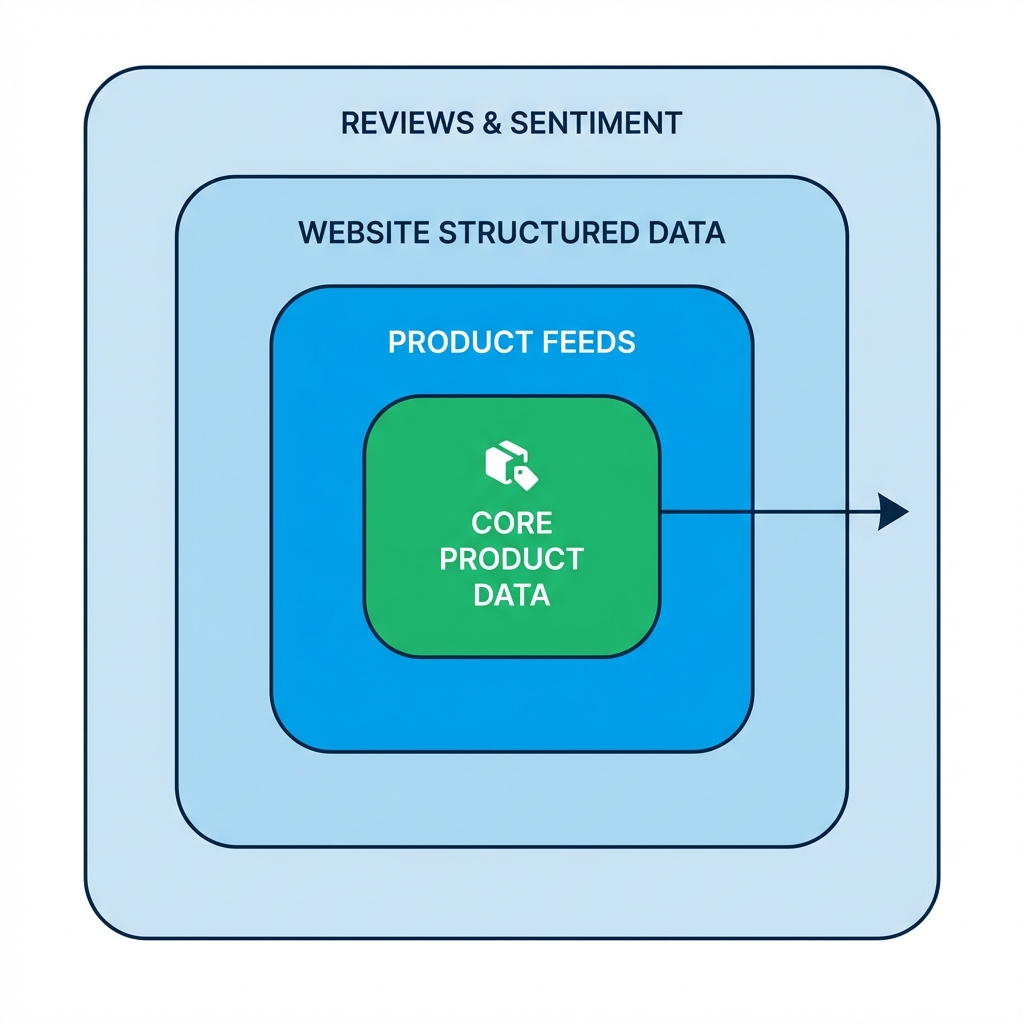
AI shopping relies on three sources:
- Product Feeds (Google Merchant Center, Facebook Catalog)
- Website Structured Data (Schema.org markup)
- Third-Party Reviews (Amazon, retail sites, review platforms)
Optimize all three for comprehensive AI visibility. Platforms like AICarma can monitor how often your products are recommended by AI shopping assistants, tracking Visibility and Sentiment across 10+ AI models.
Product Data: The Foundation of AI Commerce
The quality of your product data determines AI recommendation eligibility.
The Product Data Hierarchy
Must Have:    Title, Price, Availability, GTIN, Image
Should Have:  Category, Description, Brand, Attributes
Nice to Have: Size chart, Shipping info, Return policy, Rich media
Title Optimization
AI parses titles for key attributes. Include them explicitly:
| Weak Title | Strong Title |
|---|---|
| "Running Shoes" | "Brooks Ghost 15 Men's Running Shoes - Neutral Cushion, Size 10.5, Black/White" |
| "Laptop" | "Apple MacBook Pro 14-inch (M3 Pro, 18GB RAM, 512GB SSD) - Space Gray, 2024" |
Formula: [Brand] [Product Name] [Key Attributes] - [Variants], [Year if relevant]
Description Strategy
Descriptions should be:
- Fact-dense (specific benefits, not marketing fluff)
- Keyword-rich (natural language users might use)
- Attribute-complete (all relevant specs mentioned)
| Weak | Strong |
|---|---|
| "Premium quality headphones with amazing sound" | "Sony WH-1000XM5 wireless headphones with 30-hour battery, 40mm drivers, active noise cancellation up to 25dB reduction, multipoint Bluetooth 5.2, and 3.5mm wired option" |
The strong version contains quotable facts AI can use in recommendations.
Category Accuracy
Products must be in correct categories for AI matching:
| User Query | AI Looks In |
|---|---|
| "Running shoes for marathon" | Athletic Footwear > Running > Road Running |
| "Laptop for video editing" | Computers > Laptops > Workstation Laptops |
| "Face moisturizer for sensitive skin" | Beauty > Skincare > Face > Moisturizers |
Miscategorized products won't appear for relevant queries.
The GTIN Imperative
GTIN (Global Trade Item Number) is the product's unique identifier—UPC, EAN, ISBN, etc.
Why GTIN Matters for AI
| Function | How GTIN Helps |
|---|---|
| Product matching | AI knows exactly which product you're selling |
| Cross-source data | Links your product to reviews on other sites |
| Price comparison | Enables accurate competitive analysis |
| Authenticity signal | Indicates legitimate product listing |
The GTIN Requirement
Google Merchant Center increasingly requires GTINs. Products without them:
- May be deprioritized in Shopping results
- Can't aggregate reviews across sources
- Appear less trustworthy to AI
What to Do
| Situation | Action |
|---|---|
| Have GTINs | Include in all feeds and structured data |
| Missing GTINs | Get them from manufacturer |
| Custom products | May qualify for GTIN exemption |
| Used/vintage | Different rules apply |
GTIN in Schema
{
  "@type": "Product",
  "name": "Brooks Ghost 15 Running Shoes",
  "gtin13": "0048011582838"
}
Semantic Product Attributes
Beyond basic data, AI needs semantic attributes—descriptive properties that answer user questions.
Types of Semantic Attributes
| Category | Example Attributes |
|---|---|
| Physical | Size, weight, dimensions, color, material |
| Functional | Features, compatibility, use cases |
| Contextual | Season, occasion, target user |
| Comparative | Better than, alternative to, upgraded from |
Attribute Mapping Matrix
For each product category, map the attributes users ask about:
| User Might Ask | Attribute to Include |
|---|---|
| "For flat feet?" | arch_support_type: neutral |
| "Good for long runs?" | intended_use: marathon_training |
| "Waterproof?" | water_resistance: waterproof |
| "True to size?" | fit: runs_narrow |
| "Durable?" | estimated_lifespan: 500_miles |
Implementing Semantic Attributes
In Product Feeds:
Use product_detail or custom attributes:
<g:product_detail>
  <g:section_name>Features</g:section_name>
  <g:attribute_name>Arch Support</g:attribute_name>
  <g:attribute_value>Neutral with GlycerinFoam cushioning</g:attribute_value>
</g:product_detail>
In Schema Markup:
{
  "@type": "Product",
  "additionalProperty": [
    {
      "@type": "PropertyValue",
      "name": "Arch Support Type",
      "value": "Neutral"
    },
    {
      "@type": "PropertyValue",
      "name": "Intended Use",
      "value": "Road running, marathon training"
    }
  ]
}
Review Optimization for AI
Reviews are critical for AI recommendations—they're trust signals and used for sentiment analysis.
Why Reviews Matter More for AI
| Traditional | AI Shopping |
|---|---|
| Humans read reviews | AI reads ALL reviews |
| Users sample a few | AI analyzes every review |
| Subjective interpretation | Sentiment scoring |
| Review count matters | Review quality matters more |
The AI Review Factors
| Factor | What AI Looks For |
|---|---|
| Sentiment | Overall positive/negative balance |
| Recency | Recent reviews > old reviews |
| Quality | Detailed reviews > "Great product!" |
| Verified | Verified purchase signals trust |
| Response | Seller responses show customer care |
| Specificity | Mentions specific use cases/features |
Review Aggregation Strategy
Your product reviews exist in multiple places:
- Your own website
- Amazon
- Walmart
- Specialty retailers
AI may synthesize across sources. Ensure consistency:
- Same product identity (GTIN links them)
- Consistent brand representation
- Active review management everywhere
Getting Better Reviews
| Tactic | Impact |
|---|---|
| Post-purchase email requests | Increases volume |
| Incentivize detailed feedback | Improves quality |
| Respond to all reviews | Shows engagement |
| Address negative reviews | Demonstrates service |
Structured Data for E-commerce
Schema markup is essential for product pages.
Core Product Schema
{
  "@context": "https://schema.org",
  "@type": "Product",
  "name": "Brooks Ghost 15 Running Shoes - Men's",
  "image": [
    "https://example.com/images/ghost15-main.jpg",
    "https://example.com/images/ghost15-side.jpg"
  ],
  "description": "Neutral cushioned running shoe...",
  "sku": "BROOKS-GHOST15-M",
  "gtin13": "0048011582838",
  "brand": {
    "@type": "Brand",
    "name": "Brooks"
  },
  "offers": {
    "@type": "Offer",
    "url": "https://example.com/products/ghost-15",
    "priceCurrency": "USD",
    "price": 139.95,
    "availability": "https://schema.org/InStock",
    "priceValidUntil": "2026-12-31",
    "shippingDetails": {
      "@type": "OfferShippingDetails",
      "shippingRate": {
        "@type": "MonetaryAmount",
        "value": "0",
        "currency": "USD"
      }
    },
    "hasMerchantReturnPolicy": {
      "@type": "MerchantReturnPolicy",
      "returnPolicyCategory": "https://schema.org/MerchantReturnFiniteReturnWindow",
      "merchantReturnDays": 60
    }
  },
  "aggregateRating": {
    "@type": "AggregateRating",
    "ratingValue": "4.6",
    "reviewCount": "2847"
  }
}
Extended Attributes
Add product-specific properties:
"additionalProperty": [
  {
    "@type": "PropertyValue",
    "name": "Shoe Type",
    "value": "Road Running"
  },
  {
    "@type": "PropertyValue",
    "name": "Cushioning Level",
    "value": "High"
  },
  {
    "@type": "PropertyValue",
    "name": "Arch Support",
    "value": "Neutral"
  },
  {
    "@type": "PropertyValue",
    "name": "Weight",
    "value": "9.3 oz (Men's Size 9)"
  }
]
Variant Handling
For products with variants (size, color), use proper variant markup:
{
  "@type": "ProductGroup",
  "name": "Brooks Ghost 15",
  "variesBy": ["size", "color"],
  "hasVariant": [
    {
      "@type": "Product",
      "name": "Brooks Ghost 15 - Size 10.5 - Black",
      "size": "10.5",
      "color": "Black"
    }
  ]
}
Platform-Specific Optimization
Different AI shopping platforms have different behaviors:
Google Shopping AI (Gemini)
Key factors:
- Merchant Center feed quality
- Product reviews (Google Customer Reviews or aggregated)
- Website structured data
- Seller ratings
Focus areas:
- Complete, accurate product feeds
- Implement Google Product Structured Data
- Collect Google reviews
Amazon Rufus
Key factors:
- Amazon listing optimization
- A+ content
- Amazon reviews
- Q&A section
Focus areas:
- Keyword-rich titles and bullets
- Complete backend keywords
- Encourage Amazon reviews
- Answer questions proactively
ChatGPT Shopping
Key factors:
- Training data presence
- Website crawlability
- Brand entity strength
- Cross-source consistency
Focus areas:
- Allow GPTBot crawling
- Strong Schema markup
- Consistent product information across web
- Entity SEO for brand
| Platform | Primary Data Source | Optimization Priority |
|---|---|---|
| Google Gemini | Merchant Center | Feed quality |
| Amazon Rufus | Amazon catalog | Amazon listing |
| ChatGPT | Web crawl | Website + Schema |
| Perplexity | Live web search | Technical SEO + content |
The AI Commerce Audit
Use this audit to assess your AI commerce readiness:
Product Data Quality (Score 1-5)
| Factor | Score | Notes |
|---|---|---|
| Title completeness | /5 | All key attributes in title? |
| Description depth | /5 | Specific, quotable facts? |
| Category accuracy | /5 | In correct taxonomy? |
| GTIN coverage | /5 | All products have GTINs? |
| Image quality | /5 | Multiple, high-quality images? |
| Attribute richness | /5 | Semantic attributes present? |
Technical Infrastructure (Score 1-5)
| Factor | Score | Notes |
|---|---|---|
| Product Schema | /5 | Complete on all product pages? |
| Feed quality | /5 | Error-free, regularly updated? |
| robots.txt | /5 | AI bots allowed? |
| Page speed | /5 | Products load quickly? |
| Mobile optimization | /5 | Mobile-first experience? |
Trust Signals (Score 1-5)
| Factor | Score | Notes |
|---|---|---|
| Review volume | /5 | Sufficient reviews per product? |
| Review recency | /5 | Reviews from last 6 months? |
| Review quality | /5 | Detailed, specific reviews? |
| Seller ratings | /5 | Platform seller ratings? |
| Return policy | /5 | Clear, customer-friendly? |
Priority Matrix
| Score Range | Priority |
|---|---|
| 1-2 | Fix immediately |
| 3 | Improve within 30 days |
| 4-5 | Maintain and optimize |
FAQ
Do I need different optimization for each AI shopping platform?
Yes and no. Fundamentals (complete product data, good reviews, proper structured data) apply everywhere. But specific platforms have preferences: Google prioritizes Merchant Center feeds, Amazon Rufus only sees Amazon data, ChatGPT relies on web crawling. Optimize fundamentals first, then platform-specific tactics.
How important is GTIN really?
Critical. It's how AI systems verify product identity across sources. Without GTIN, AI can't confidently match your product to reviews, price comparisons, or specification databases. Products without GTINs are increasingly disadvantaged.
My products are custom/handmade—can I still optimize for AI shopping?
Yes, but with different strategies. Focus on detailed semantic attributes since you won't have cross-site data aggregation. Collect rich reviews that describe the custom nature. Use descriptive structured data even without GTIN.
How do reviews on my site vs. Amazon affect AI recommendations?
AI synthesizes across sources. Amazon reviews often carry more weight due to verified purchase status and volume. But your on-site reviews matter too, especially when linked via Schema. Optimize both, but prioritize where your customers shop and where AI platforms most actively pull data.
What's the ROI of AI commerce optimization?
Track: (1) AI-referred traffic (from shopping surfaces), (2) Conversion rate of that traffic, (3) Revenue per AI visit vs. traditional. Many brands see higher conversion rates from AI-referred shoppers because they're pre-qualified. The investment in product data quality pays dividends across all channels, not just AI.